

Power outages, cyberattacks, or unexpected flooding can threaten the core functions of small law firms and medical offices in Arizona and Colorado. For IT managers, every minute of downtime puts compliance and client trust at risk. Comprehensive disaster recovery solutions offer a proven way to keep critical systems running, meet regulatory demands, and protect sensitive information when disruption strikes.
Table of Contents
- Defining Disaster Recovery And Core Principles
- Types Of Disaster Recovery Plans For Businesses
- Key Components In A Recovery Strategy
- Compliance And Legal Requirements In Arizona
- Risks, Costs, And Common Implementation Mistakes
Key Takeaways
| Point | Details |
|---|---|
| Disaster Recovery Principles | Organizations should adopt community-driven strategies, collaborative operations, and focus on resilience in planning for disaster recovery. |
| Types of Recovery Plans | Key plan types include IT Infrastructure, Communication, Operational Continuity, Physical Asset, and Human Resources Recovery, each addressing different aspects of organizational resilience. |
| Compliance in Arizona | Businesses must comply with state laws related to emergency management, data protection, and infrastructure resilience to effectively manage disaster recovery. |
| Implementation Mistakes | Common pitfalls include inadequate risk assessments and insufficient budget allocations, which can undermine recovery efforts and lead to significant financial costs. |
Defining Disaster Recovery and Core Principles
Disaster recovery represents a strategic approach organizations use to protect critical business operations during unexpected disruptions. At its core, disaster recovery involves creating comprehensive plans and systems that enable businesses to rapidly respond, adapt, and continue functioning when significant technological, environmental, or operational challenges emerge.
The National Disaster Recovery Framework highlights several core principles that guide effective disaster management. These principles include:
- Community-Driven Strategies: Recovery efforts must be locally defined and responsive to specific community needs
- Collaborative Operations: Unified coordination between different stakeholders and recovery coordinators
- Resilience Focus: Restoring and revitalizing critical community infrastructure and economic systems
- Adaptive Planning: Developing flexible frameworks that can respond to diverse disaster scenarios
Businesses implementing disaster recovery strategies must recognize that preparedness goes beyond simple backup systems. Comprehensive disaster recovery research emphasizes building robust networks that leverage human, social, political, and economic resources to enhance organizational adaptability.
Successful disaster recovery demands a multifaceted approach that integrates technological solutions with strategic human capital management. Organizations must identify key leaders, establish clear communication protocols, and develop training programs that enable rapid, coordinated responses to potential disruptions.
Pro tip: Conduct regular disaster recovery scenario simulations to test and refine your organization’s response capabilities and identify potential systemic vulnerabilities.
Types of Disaster Recovery Plans for Businesses
Disaster recovery plans are critical strategic tools that help organizations maintain operational resilience during unexpected disruptions. These comprehensive plans provide structured frameworks for responding to various potential threats that could compromise business continuity and infrastructure.
Business Impact Analysis serves as the foundational step in developing effective disaster recovery strategies. Organizations typically categorize their disaster recovery plans into several key types:
- IT Infrastructure Recovery Plan: Focuses on restoring technological systems and digital assets
- Communication Recovery Plan: Establishes protocols for maintaining internal and external communication during crises
- Operational Continuity Plan: Ensures critical business processes can continue with minimal interruption
- Physical Asset Recovery Plan: Addresses restoration of physical facilities and equipment
- Human Resources Recovery Plan: Manages workforce safety and operational capabilities during emergencies
The National Disaster Recovery Framework recommends developing integrated plans that address multiple dimensions of organizational resilience. These plans must be adaptive, covering response mechanisms, recovery support functions, and long-term mitigation strategies.
Successful disaster recovery planning requires a holistic approach that goes beyond simple technical solutions. Organizations must conduct thorough risk assessments, identify critical business processes, and develop flexible strategies that can be quickly implemented across different disaster scenarios.

Here’s a comparison of common disaster recovery plan types and their primary business focus:
| Plan Type | Main Focus | Typical Benefit |
|---|---|---|
| IT Infrastructure Recovery | Restoring digital systems | Minimizes technology downtime |
| Communication Recovery | Maintaining clear communication | Reduces confusion during crises |
| Operational Continuity | Keeping core processes running | Preserves revenue and reputation |
| Physical Asset Recovery | Repairing facilities and equipment | Speeds up physical recovery |
| Human Resources Recovery | Workforce safety and coordination | Ensures staff well-being and roles |
Pro tip: Regularly update and test your disaster recovery plans to ensure they remain current with your organization’s evolving technological and operational landscape.
Key Components in a Recovery Strategy
A robust disaster recovery strategy requires meticulous planning and comprehensive understanding of an organization’s critical operational needs. Identifying mission-critical services represents the foundational step in developing an effective recovery framework that can withstand unexpected disruptions.
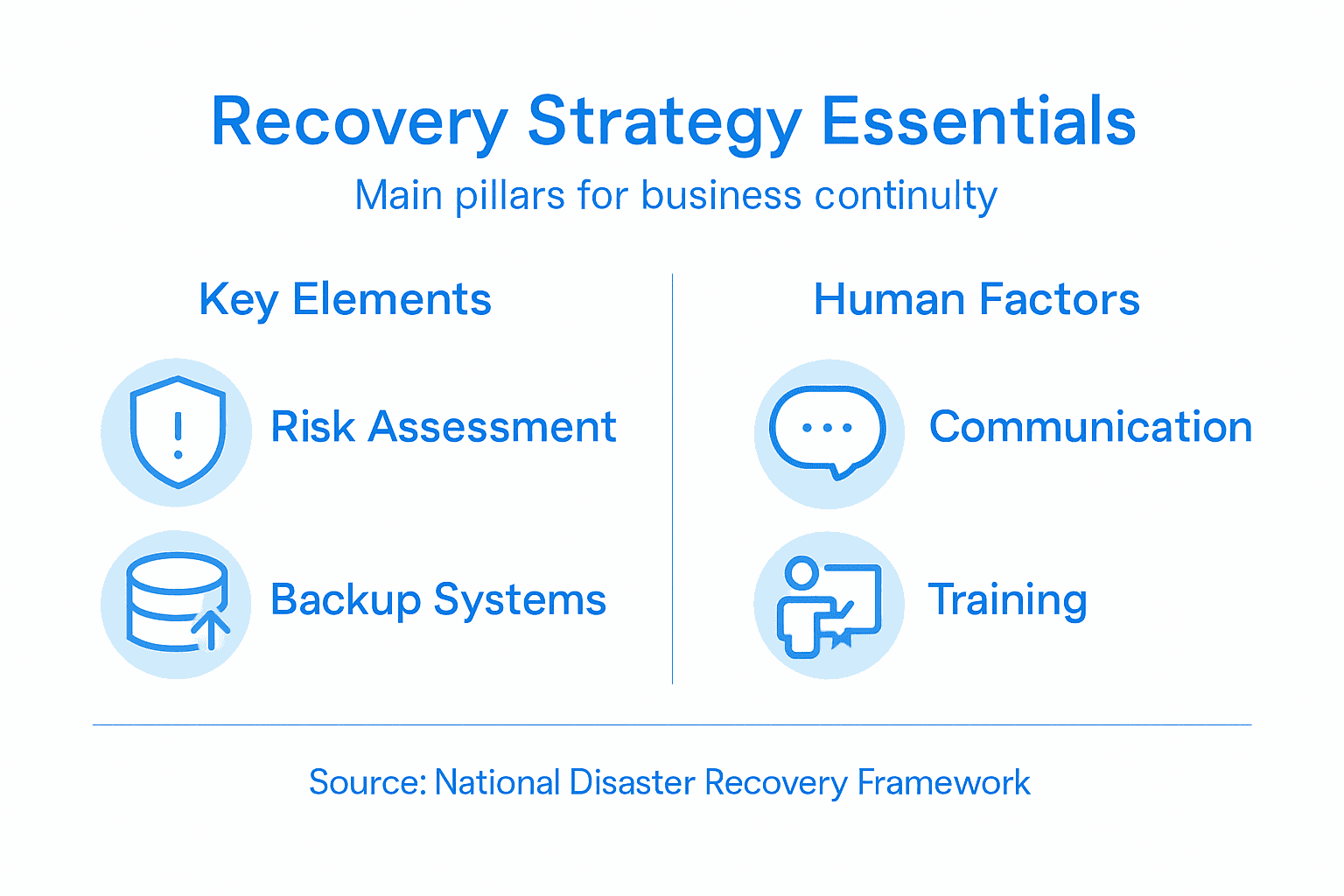
Key components of a comprehensive disaster recovery strategy include:
- Risk Assessment: Thoroughly evaluate potential threats and vulnerabilities
- Business Impact Analysis: Determine critical functions and their recovery priorities
- Recovery Time Objectives: Establish precise timelines for system and service restoration
- Communication Protocols: Define clear communication channels during crisis scenarios
- Resource Allocation: Identify and pre-position necessary resources for rapid response
- Backup and Restoration Mechanisms: Develop comprehensive data protection and recovery systems
The National Disaster Recovery Framework emphasizes the importance of coordinated efforts across multiple organizational levels. This approach requires clear delegation of recovery roles, integrating risk management strategies, and creating adaptable frameworks that can respond to diverse disaster scenarios.
Effective recovery strategies extend beyond technical solutions, requiring a holistic approach that considers human resources, technological infrastructure, and organizational resilience. Organizations must develop flexible plans that can be quickly implemented and continuously refined through regular testing and scenario simulations.
Pro tip: Conduct quarterly disaster recovery drills to identify potential gaps and continuously improve your organization’s response capabilities.
Compliance and Legal Requirements in Arizona
Businesses operating in Arizona must navigate a complex landscape of legal requirements governing disaster recovery and emergency management. Arizona state laws establish critical frameworks that define responsibilities and compliance standards for organizations preparing for potential disruptions.
Key legal compliance requirements for businesses in Arizona include:
- State Emergency Management Regulations: Adherence to Arizona Revised Statutes governing emergency preparedness
- Data Protection Mandates: Compliance with state-specific privacy and information security requirements
- Reporting Obligations: Mandatory reporting of incidents and recovery activities to relevant state authorities
- Infrastructure Resilience Standards: Meeting state guidelines for critical infrastructure protection
- Communication Continuity Requirements: Ensuring uninterrupted communication during emergency scenarios
The National Disaster Recovery Framework provides additional guidance for aligning organizational practices with federal and state regulations. This framework emphasizes the importance of creating comprehensive recovery plans that not only meet legal standards but also protect the fundamental operational capabilities of businesses across Arizona.
For industries with specialized compliance needs, such as healthcare and financial services, additional regulatory layers require even more nuanced disaster recovery strategies. Organizations must develop flexible frameworks that can rapidly adapt to changing legal landscapes while maintaining robust protection of critical business functions.
Pro tip: Consult with local legal experts specializing in emergency management to ensure your disaster recovery strategy fully meets Arizona’s specific regulatory requirements.
Risks, Costs, and Common Implementation Mistakes
Disaster recovery represents a complex financial and operational challenge that can significantly impact an organization’s long-term sustainability. Economic burdens of disaster recovery extend far beyond immediate repair costs, encompassing lost productivity, infrastructure disruption, and potential long-term business viability.
Common implementation mistakes that organizations frequently encounter include:
- Inadequate Risk Assessment: Failing to comprehensively evaluate potential disaster scenarios
- Poor Stakeholder Engagement: Not involving key personnel in recovery planning
- Insufficient Budget Allocation: Underestimating the financial resources required for comprehensive recovery
- Outdated Recovery Protocols: Neglecting to regularly review and update disaster response strategies
- Limited Communication Frameworks: Weak interdepartmental communication during crisis situations
- Minimal Testing and Simulation: Lack of regular disaster recovery scenario exercises
The financial implications of disaster recovery can be substantial, with costs potentially including property damage, operational interruption, technology replacement, and extended recovery periods. Organizations must develop nuanced strategies that balance proactive investment with realistic risk mitigation approaches.
Successful disaster recovery planning requires a holistic approach that transcends traditional risk management. Businesses must develop adaptive frameworks that can quickly respond to diverse and unpredictable disruption scenarios while maintaining operational resilience and financial stability.
The table below summarizes major risks, costs, and mitigation strategies for disaster recovery implementation:
| Risk Area | Potential Cost | Mitigation Strategy |
|---|---|---|
| Property Damage | High repair and replacement costs | Insurance and proactive upgrades |
| Lost Productivity | Decreased output and delays | Fast recovery protocols |
| Outdated Protocols | Slow or failed recovery response | Frequent scenario testing |
| Weak Communication | Decision making delays | Robust crisis communication plan |
| Budget Shortfall | Incomplete recovery and exposure | Realistic cost-benefit analysis |
Pro tip: Conduct annual comprehensive disaster recovery cost-benefit analyses to ensure your investment in preparedness remains proportional and strategically aligned with potential risks.
Strengthen Your Business Continuity with Voipcom’s Cloud Communications
The article highlights the critical challenge of protecting business operations during unexpected disasters through comprehensive recovery strategies. If your organization is concerned about minimizing downtime, maintaining clear communication, and restoring vital systems quickly after any disruption Voipcom offers precisely the kind of scalable and resilient solutions you need. Our cloud-based phone and communications services provide modern hosted PBX systems, integrated messaging, and AI-powered calling features designed to keep your team connected and productive even in crisis situations.

Take action now to future-proof your business communications with Voipcom’s fully managed services featuring real-time support and seamless integration with tools like Microsoft Teams. Our solutions are tailored for small and medium businesses that demand reliability and flexibility during emergencies. Learn more about how you can build a robust communication recovery plan by visiting Voipcom and explore vital resources such as our Backup and Restoration Mechanisms to enhance your disaster recovery readiness. Don’t wait for the next disruption to reveal your vulnerabilities—secure your voice and messaging systems today.
Frequently Asked Questions
What is disaster recovery?
Disaster recovery is a strategic approach that organizations use to protect essential business operations during unexpected disruptions, enabling rapid response and continuity of functions.
What are the key types of disaster recovery plans?
Common types of disaster recovery plans include IT Infrastructure Recovery Plans, Communication Recovery Plans, Operational Continuity Plans, Physical Asset Recovery Plans, and Human Resources Recovery Plans, each focusing on different aspects of business continuity.
What are the main components of an effective disaster recovery strategy?
Key components include risk assessment, business impact analysis, recovery time objectives, communication protocols, resource allocation, and backup and restoration mechanisms to ensure comprehensive recovery.
What are common mistakes made during disaster recovery implementation?
Common mistakes include inadequate risk assessments, poor stakeholder engagement, insufficient budget allocation, outdated recovery protocols, weak communication frameworks, and minimal testing and simulation, which can hinder effective recovery efforts.