

Most American companies are switching to internet-based communication, and for good reason. Over 50 percent of businesses now rely on Voice Over IP for daily operations, highlighting a major shift away from traditional phone lines. Companies want to cut costs while gaining features that keep them competitive in a fast-moving world. Understanding how VoIP works gives you the perspective needed to make smarter choices about your own business communications.
Table of Contents
- Defining Voice Over IP And How It Works
- Major Types Of VoIP Solutions For Business
- Essential Features And Real-World Applications
- Integration, Security, And Compliance Concerns
- Risks, Costs, And VoIP Vs. Traditional Phones
Key Takeaways
| Point | Details |
|---|---|
| VoIP Transforms Communication | VoIP technology converts voice signals into digital data, facilitating cost-effective communication and enhanced flexibility for businesses. |
| Diverse Deployment Models Available | Businesses can choose from hosted, on-premises, or hybrid VoIP solutions, allowing for tailored communication strategies based on specific needs. |
| Integration and Security Considerations | Successful VoIP implementation requires thorough planning for network compatibility, cybersecurity measures, and compliance with regulatory standards. |
| Cost Benefits of VoIP | VoIP offers substantial financial savings over traditional systems, including lower monthly expenses and reduced infrastructure investments. |
Defining Voice Over IP and How It Works
Voice Over Internet Protocol (VoIP) represents a revolutionary communication technology that transforms how businesses connect and collaborate. At its core, VoIP converts traditional voice signals into digital data packets that can be transmitted seamlessly across internet networks, replacing outdated analog telephone systems.
The technical magic behind VoIP involves converting sound waves from your voice into digital information that can travel instantly across complex network infrastructures. Voice communication sessions now flow through IP networks, allowing for unprecedented flexibility compared to traditional phone systems. Modern VoIP solutions enable businesses to make calls using computers, specialized VoIP phones, or even mobile devices with internet connectivity.
Understanding VoIP’s functionality reveals multiple transmission methods. Businesses can connect through:
- SIP Trunking: Direct digital communication channels
- Cloud-Based Phone Systems: Remote call routing
- Softphone Applications: Software-based telephone interfaces
- Hardware VoIP Phones: Dedicated internet-connected devices
Pro Business Communication Strategy: Research and select a VoIP provider that offers scalable solutions matching your specific organizational communication needs, ensuring seamless integration with existing technology infrastructure.
By leveraging internet protocols, VoIP provides significantly more robust communication capabilities than traditional landline systems, enabling businesses to reduce costs while increasing operational flexibility.
Major Types of VoIP Solutions for Business
Businesses today have multiple VoIP solution architectures to choose from, each offering unique advantages for modern communication strategies. The three primary VoIP deployment models provide organizations with flexible options to match their specific operational requirements and technological infrastructure.
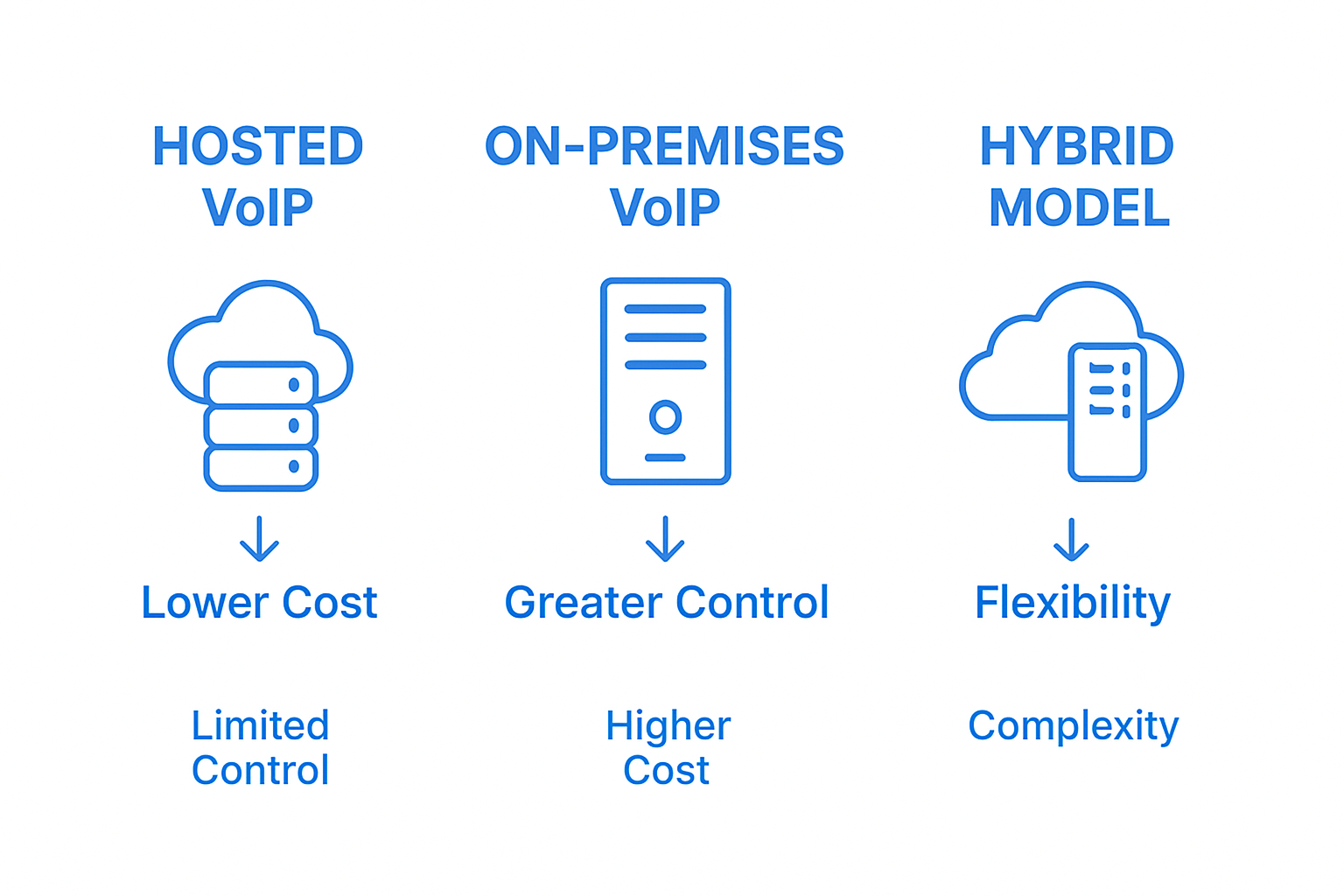
Hosted VoIP Services represent a cloud-based solution where third-party providers manage the entire communication system. These solutions offer exceptional scalability, reduced upfront infrastructure costs, and minimal internal maintenance responsibilities. Small to medium-sized businesses frequently gravitate toward hosted VoIP because it eliminates complex technical management while providing enterprise-grade communication capabilities.

On-Premises VoIP Systems give organizations complete control over their communication infrastructure. Companies with robust IT departments and specific security requirements often prefer this model, as it allows for deep customization, advanced configuration options, and complete data sovereignty. While requiring more significant initial investment and ongoing technical management, on-premises solutions provide unparalleled flexibility for businesses with unique communication needs.
Hybrid VoIP Models combine elements from both hosted and on-premises approaches, creating a versatile communication strategy. These solutions enable businesses to maintain certain critical systems internally while leveraging cloud-based technologies for additional functionality. Hybrid models prove particularly effective for organizations transitioning between communication architectures or requiring a nuanced approach to technological integration.
Pro Network Design Strategy: Conduct a comprehensive audit of your current communication infrastructure before selecting a VoIP solution, ensuring the chosen model aligns precisely with your organization’s technological capabilities, budget constraints, and long-term growth objectives.
Here’s a summary comparing the main VoIP deployment models for businesses:
| VoIP Model | Ideal For | Main Advantage | Key Consideration |
|---|---|---|---|
| Hosted | Small to medium enterprises | Low IT management required | Reliant on external provider |
| On-Premises | Large companies, high security | Total control and customization | Higher initial investment |
| Hybrid | Transitioning organizations | Flexibility and tailored setup | Coordination of dual systems |
Essential Features and Real-World Applications
VoIP technology has revolutionized business communications by offering a comprehensive suite of features that extend far beyond traditional phone systems. VoIP systems provide powerful communication tools that transform how organizations interact, collaborate, and maintain professional connectivity across diverse operational environments.
Core Communication Features include advanced capabilities that dramatically enhance business efficiency:
- Call Routing: Intelligent call distribution across multiple devices and locations
- Voicemail to Email: Automatic transcription and digital message forwarding
- Conference Calling: Seamless multi-participant communication
- Caller ID and Call Screening: Enhanced communication management
- Mobile Integration: Unified communication across smartphones, desktops, and tablets
Real-world applications of VoIP technology span multiple industries and operational contexts. Call centers leverage these systems to manage high-volume customer interactions, routing calls efficiently and tracking performance metrics. Remote work teams utilize VoIP’s flexibility to maintain professional communication regardless of physical location, enabling global collaboration with minimal infrastructure investment.
Enterprise-level VoIP solutions offer deep integration with customer relationship management (CRM) platforms, creating a unified communication ecosystem. This integration allows businesses to track customer interactions, log communication histories, and streamline customer support processes with unprecedented precision and efficiency.
Pro Communication Strategy: Evaluate your organization’s specific communication needs comprehensively, selecting a VoIP solution that offers scalable features and seamless integration with your existing technological infrastructure.
Integration, Security, and Compliance Concerns
Businesses considering VoIP technology must navigate a complex landscape of technical integration, cybersecurity challenges, and regulatory compliance. Integrating VoIP systems requires meticulous planning to ensure compatibility with existing technological infrastructures while maintaining robust security protocols.
Technological Integration Challenges demand comprehensive strategies that address multiple critical dimensions:
- Network Compatibility: Ensuring seamless communication across different hardware and software platforms
- Bandwidth Requirements: Analyzing and optimizing network capacity for high-quality voice transmission
- Existing System Migration: Developing smooth transition plans from legacy communication systems
- API and Software Interoperability: Creating flexible integration points with existing business applications
Cybersecurity represents a paramount concern in VoIP implementation. Potential vulnerabilities include sophisticated threats like:
- Potential eavesdropping on digital communication channels
- Denial-of-service attack vectors
- Unauthorized access to communication networks
- Data interception and manipulation risks
Regulatory compliance adds another layer of complexity, particularly for industries with stringent communication standards. Organizations must carefully navigate requirements from federal agencies like the Federal Communications Commission, ensuring that VoIP implementations meet all legal and professional standards. This includes maintaining data privacy, protecting communication integrity, and implementing robust security measures.
Pro Security Strategy: Conduct a comprehensive security audit before VoIP implementation, identifying potential vulnerabilities and developing a multilayered protection strategy that addresses technological, operational, and regulatory requirements.
This table summarizes integration and security priorities when adopting VoIP:
| Concern Category | Example Focus | Business Impact |
|---|---|---|
| Integration | API and software compatibility | Maximized operational efficiency |
| Cybersecurity | Encryption and access controls | Reduced risk of data breaches |
| Compliance | Regulatory adherence | Avoidance of legal penalties |
Risks, Costs, and VoIP vs. Traditional Phones
VoIP technologies offer substantial cost advantages by leveraging existing internet infrastructure, fundamentally transforming how businesses approach communication expenses and technological investments. The transition from traditional phone systems represents a strategic shift that demands careful economic and operational analysis.
Cost Comparison Breakdown:
- Initial Investment: VoIP requires minimal hardware compared to traditional phone systems
- Monthly Expenses: Significantly lower telecommunications costs
- Maintenance: Reduced technical support and infrastructure maintenance
- Scalability: Easy addition of new lines without substantial hardware upgrades
Traditional phone systems rely on dedicated copper wire infrastructures, creating substantial overhead costs. In contrast, VoIP transforms voice communications into digital data packets, enabling businesses to utilize existing network resources. This technological approach eliminates the need for separate voice and data communication networks, generating substantial long-term financial efficiencies.
Potential Risks to Consider:
- Internet connectivity dependence
- Potential service interruptions during network issues
- Cybersecurity vulnerabilities
- Quality of service variations based on network performance
While VoIP introduces remarkable flexibility, businesses must implement robust backup systems and maintain reliable internet connections to mitigate potential communication disruptions. Advanced VoIP providers offer comprehensive solutions that address these concerns through redundant network configurations and proactive monitoring technologies.
Pro Technology Transition Strategy: Conduct a comprehensive infrastructure audit and pilot test VoIP solutions with a small team before full-scale implementation, ensuring seamless integration and identifying potential performance challenges.
Unlock Modern Business Communication with Voipcom
The article highlights the challenges businesses face when transitioning from legacy phone systems to flexible Voice Over IP solutions like SIP trunking, hosted VoIP, and hybrid models. If complexity, high costs, or limited remote work capabilities are holding your organization back, you are not alone. Key pain points include ensuring seamless integration, maintaining security and compliance, and accessing scalable features such as mobile integration and AI-powered calling.
Voipcom specializes in delivering cloud-based phone systems designed to solve these exact challenges. Our fully managed Hosted PBX solutions simplify the migration process while reducing communication expenses. We support remote and hybrid workforces with robust features like voicemail-to-email, Microsoft Teams integration, and AI tools for smarter calling. Plus, our local support team ensures your business stays connected with no surprise fees.
Ready to embrace a modern communication experience that aligns with your business goals and technical needs?
Explore our comprehensive communication services today.

Take the first step toward seamless, secure, and scalable business communication. Visit Voipcom now to get started with a solution tailored to your unique requirements.
Frequently Asked Questions
What is Voice Over Internet Protocol (VoIP) and how does it work?
VoIP is a technology that converts voice signals into digital data packets, allowing for communication over the internet instead of traditional phone lines. It enables businesses to make calls using devices like computers, VoIP phones, and mobile phones connected to the internet.
What are the main types of VoIP solutions available for businesses?
The three primary types of VoIP solutions for businesses include Hosted VoIP Services, On-Premises VoIP Systems, and Hybrid VoIP Models. Hosted solutions are managed by a third party in the cloud, on-premises systems allow for complete control by the organization, and hybrid models combine both approaches for flexibility.
What essential features should I expect from a VoIP system?
Core communication features of VoIP systems include call routing, voicemail to email, conference calling, caller ID, call screening, and mobile integration, enhancing business efficiency and facilitating seamless communication.
What security concerns should businesses be aware of when implementing VoIP?
Businesses need to consider cybersecurity threats such as eavesdropping, denial-of-service attacks, unauthorized network access, and data interception. Additionally, compliance with regulatory standards is crucial to maintaining data privacy and communication integrity.