


Many small business owners in Arizona and Colorado believe switching to VoIP requires complex, expensive infrastructure changes. Modern cloud-hosted phone systems actually slash upfront costs by up to 70% while simplifying management. This guide reveals proven strategies for cutting telecom expenses, eliminating hidden fees, and maximizing operational efficiency through smart office phone investments tailored for regional SMBs.
Key takeaways
| Point | Details |
|---|---|
| Cloud VoIP reduces costs | Transitioning to cloud-hosted systems cuts hardware and telecom expenses substantially while simplifying infrastructure. |
| Advanced features boost efficiency | AI call routing, mobile apps, and voicemail transcription improve productivity and reduce administrative overhead. |
| Transparent pricing prevents surprises | All-inclusive pricing models and local support eliminate unexpected fees and simplify budget planning. |
| Number porting preserves continuity | Porting existing numbers maintains customer contact channels and prevents disruptions during provider transitions. |
| Integration supports hybrid work | Platforms like Microsoft Teams consolidate communications, reduce infrastructure costs, and enable flexible work arrangements. |
Understanding modern office phone systems
The telecommunications landscape has shifted dramatically from legacy PBX hardware to internet-based systems. Traditional phone systems required expensive on-premises equipment, dedicated phone lines, and costly maintenance contracts. Modern IP office phone systems reduce telephony costs by lowering monthly access fees through SIP trunking, decreasing long-distance charges through internet routing, and consolidating hardware into cloud-managed platforms.
Related: cloud phone systems for Chandler businesses, cloud phone systems for Greenwood Village businesses, and business VoIP with local setup and support.
Key technologies driving this transformation include SIP trunking, which converts voice signals into data packets, and cloud hosting, which eliminates physical hardware requirements. In 2026, market trends show accelerated cloud adoption as businesses recognize the financial and operational advantages of hosted solutions.
Cost savings emerge from multiple sources. Hardware reduction eliminates purchase and maintenance expenses for physical phone systems. Telecom fee changes through internet-based calling cut per-minute charges and line rental costs. Understanding VoIP versus legacy phone systems helps businesses evaluate potential savings accurately.
Modern systems offer capabilities impossible with traditional setups:
- Remote worker support through mobile apps and softphones
- Instant scalability without hardware installations
- Advanced analytics for call tracking and performance monitoring
- Integration with business applications like CRM platforms
- Automated call routing based on time, caller ID, or custom rules
Businesses exploring options should review cloud phone system pricing models to understand typical cost structures and feature sets available in 2026.
How IP phone systems reduce costs for SMBs
SIP trunking reduces monthly line costs by up to 40%, with international call savings exceeding 50%. This technology replaces traditional phone lines with internet connections, eliminating per-line rental fees that accumulate quickly for multi-user businesses.

Internet calling transforms long-distance and international communication expenses. Calls route through existing internet infrastructure rather than traditional telecom networks, cutting charges dramatically. Cloud hosting removes expensive hardware maintenance contracts, replacing them with predictable monthly subscription fees.
| Cost Factor | Legacy System | Cloud-Hosted VoIP |
|---|---|---|
| Monthly line fees | $40-60 per line | $20-30 per user |
| Hardware investment | $500-1,500 per phone | $0-150 per device |
| Maintenance costs | $200-500 monthly | Included in subscription |
| Long-distance charges | $0.10-0.25 per minute | $0.01-0.05 per minute |
| Scalability costs | High (new hardware) | Low (software licensing) |
Major cost-saving mechanisms include:
- Elimination of dedicated phone line installations and monthly rental fees
- Consolidated billing that covers all features in one predictable payment
- Reduced IT support requirements through cloud-managed platforms
- Lower bandwidth costs as voice quality improves with modern codecs
- Instant provisioning of new users without truck rolls or hardware shipping
Comparing VoIP versus legacy phone systems reveals typical SMBs save 30-50% on total telecom expenses within the first year of switching. These savings compound over time as hardware refresh cycles extend and remote work capabilities eliminate office space requirements.
Cost-saving features and operational efficiencies
Administrative call management time reduces by 30-50% through AI-assisted call routing and mobile softphones. These features automate tasks that previously required dedicated staff or consumed valuable employee time, creating indirect savings beyond direct telecom cost reductions.
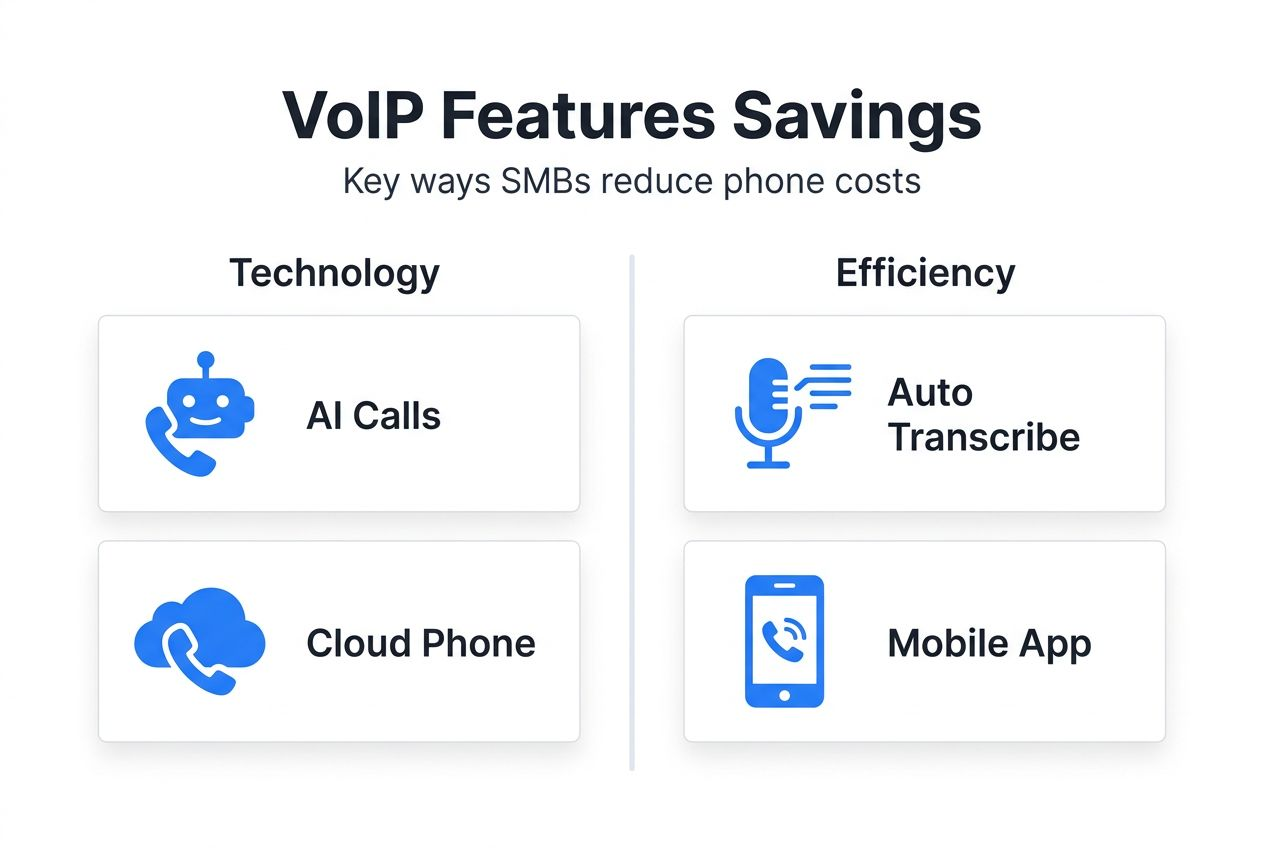
Voicemail transcription and voicemail-to-email capabilities transform communication responsiveness. Messages arrive as text in email inboxes, allowing quick scanning and prioritization without listening to entire recordings. This feature proves especially valuable for mobile workers and busy executives who need rapid information access.
Mobile and softphone applications enable remote work without purchasing additional desk phones. Employees use existing smartphones or computers as full-featured business phones, accessing company directories, call queues, and advanced features anywhere with internet connectivity. This flexibility reduces hardware investments while supporting hybrid work models.
Scalability features minimize costs when adjusting team sizes:
- Adding users requires only software licensing, no hardware purchases
- Removing users involves canceling subscriptions with no equipment disposal
- Seasonal staffing changes happen instantly through administrative portals
- Geographic expansion occurs without installing phone systems in new locations
- Department restructuring adapts quickly without rewiring or hardware moves
Pro Tip: Calculate feature ROI by tracking time savings alongside cost reductions. A feature saving 30 minutes daily per employee generates substantial value even if direct cost savings appear modest.
Exploring top VoIP features for businesses helps identify which capabilities deliver maximum value for specific operational needs. Organizations should prioritize features addressing current pain points rather than adopting everything available. Understanding AI in telecommunications trends helps businesses prepare for upcoming innovations that will further enhance efficiency.
Managing hidden fees and billing optimization
Duplicate and incorrect telecom charges inflate costs by 2-5% across typical business phone bills. These errors accumulate unnoticed without systematic auditing, creating unnecessary expense drains that compound monthly. Automated telecom auditing tools detect billing errors in real time, flagging anomalies like duplicate line charges, incorrect rate applications, or unauthorized feature additions.
Dispute management processes recover overbilled amounts through systematic carrier communication and documentation. Many businesses lack time or expertise to challenge telecom billing errors effectively, leaving money on the table. Professional auditing services handle disputes, securing refunds and correcting ongoing billing problems.
Typical hidden fees to monitor include:
- Regulatory recovery fees that vary by carrier and often exceed actual costs
- Number porting charges despite provider claims of free porting
- Directory listing fees for services never requested or used
- Equipment rental charges for hardware purchased outright
- Early termination penalties buried in contract fine print
- Administrative fees with vague descriptions and variable amounts
Pro Tip: Schedule quarterly bill reviews using automated auditing tools or professional services. The time investment recovers significantly more in identified overcharges and prevents future billing errors.
Transparent providers eliminate many hidden fees through all-inclusive pricing models. Research shows businesses prefer predictable costs over slightly lower base rates with surprise charges. Reviewing the cost-effective phone system setup guide helps identify pricing structures that prevent billing surprises. Additional context on reducing telecom costs demonstrates industry best practices for expense management.
Implementing transparent pricing and local support
Transparent pricing cuts unexpected charges by up to 35% compared to traditional telecom contracts with complex fee structures. All-inclusive pricing models bundle features, support, and infrastructure costs into single monthly rates without surprise additions. This approach simplifies budgeting and eliminates the hidden fees that plague legacy phone system billing.
No setup or porting fees simplify initial transition planning. Traditional carriers often charge hundreds or thousands for implementation services, number transfers, and system configuration. Modern providers include these services in standard offerings, reducing barrier-to-entry costs significantly.
Responsive local support enables fast issue resolution, minimizing business disruption when problems occur. Regional support teams understand local business environments, regulations, and customer needs better than distant call centers. This proximity translates to faster response times and more relevant solutions.
Benefits of local vendor partnerships include:
- Same-day on-site support for critical hardware issues
- Regional expertise in Arizona and Colorado business requirements
- Familiarity with local network infrastructure and service quality
- Direct accountability without layers of corporate bureaucracy
- Relationship-based service that prioritizes long-term customer success
- Understanding of regional business cycles and seasonal communication needs
All-inclusive plans typically cover phone system hosting, unlimited calling, standard features, ongoing maintenance, software updates, and technical support under one monthly fee. This bundling eliminates surprise charges for routine needs while providing cost predictability essential for small business budget management.
Exploring advantages of VoIP for SMBs reveals how pricing transparency and local support combine to create superior value propositions. Understanding network management benefits shows how managed services reduce internal IT burdens while maintaining system reliability.
Integration benefits: Microsoft Teams and unified communications
Teams Phone adoption cuts telecom infrastructure costs by 25%, with a 15% increase in remote worker efficiency. This integration consolidates voice, video, chat, and collaboration into single platforms, eliminating redundant systems and associated licensing costs. Businesses already using Microsoft 365 gain particular value by leveraging existing subscriptions rather than paying separately for standalone phone systems.
Unified communications platforms support hybrid work by enabling seamless communication across devices and locations. Employees switch between desk phones, computers, and mobile devices without call interruptions or feature limitations. This flexibility proves essential as businesses maintain remote work options established during recent workplace transformations.
| System Type | Infrastructure Cost | Remote Capability | Integration Level | Management Complexity |
|---|---|---|---|---|
| Traditional phone system | High (dedicated hardware) | Limited (forwarding only) | Minimal (standalone) | High (specialized skills) |
| Standalone VoIP | Medium (network equipment) | Good (softphones available) | Moderate (APIs available) | Medium (IT staff needed) |
| Unified communications platform | Low (cloud-based) | Excellent (native multi-device) | High (integrated workspace) | Low (single admin portal) |
Major unified communications benefits for hybrid SMBs include:
- Single interface for all communication types reduces training requirements
- Presence indicators show colleague availability across devices and locations
- Screen sharing and collaboration tools integrate directly with calling features
- Meeting recordings and transcriptions create searchable communication archives
- Mobile apps provide full feature access for traveling and remote employees
- Calendar integration enables automatic call routing based on scheduled activities
Businesses should evaluate current Microsoft 365 licensing to identify available Teams Phone features before purchasing additional phone system solutions. Understanding VoIP impact on remote work helps organizations maximize value from unified communications investments while supporting flexible work arrangements.
Common misconceptions about VoIP and cost
Myth: VoIP requires expensive, complex on-premises hardware for reliable operation. Fact: Cloud-hosted VoIP reduces upfront hardware expenses by up to 70%, contrary to perceptions of costly equipment requirements. Modern systems operate entirely in cloud infrastructure, requiring only internet connections and optional desk phones or softphone applications.
Myth: Switching phone providers means losing established business phone numbers and customer contact channels. Fact: Phone number porting preserves complete continuity and brand identity through regulated transfer processes. Carriers must release numbers upon request, enabling businesses to maintain all existing phone numbers when changing providers. This process typically completes within 7 to 14 business days with zero customer-facing disruption.
Myth: Telecom billing accuracy is reliable, and reviewing bills wastes time without providing value. Fact: Billing errors appear frequently across carrier invoices, with duplicate charges, incorrect rates, and unauthorized features common. Systematic auditing consistently identifies overcharges that justify the review time investment many times over.
Additional misconceptions businesses should reconsider:
- Small businesses lack resources for VoIP adoption (reality: cloud systems require minimal IT expertise)
- Call quality suffers compared to traditional phone lines (reality: modern codecs deliver superior audio)
- Internet outages eliminate all phone service (reality: mobile failover and call forwarding maintain connectivity)
- VoIP systems lack reliability for business-critical communications (reality: carrier-grade infrastructure exceeds traditional system uptime)
- Security risks exceed traditional phone system vulnerabilities (reality: encrypted VoIP offers stronger security than analog lines)
Reviewing VoIP adoption tips for businesses addresses common concerns with practical implementation guidance. Understanding proper network cabling infrastructure ensures reliable service quality that exceeds legacy system performance.
Practical steps for SMBs transitioning from legacy systems
Successful transitions follow structured approaches that minimize disruption while maximizing cost savings. These steps guide Arizona and Colorado SMBs through the process systematically:
-
Evaluate current telecom expenses by collecting six months of phone bills and identifying all costs including hidden fees, long-distance charges, equipment rentals, and maintenance contracts to establish a baseline for comparison.
-
Document pain points like poor call quality, limited features, difficult user management, inadequate remote work support, or frustrating vendor interactions to prioritize requirements for new systems.
-
Research providers offering transparent pricing, local support in Arizona or Colorado, all-inclusive feature sets, and managed implementation services that align with documented requirements and budget constraints.
-
Request detailed proposals from top provider candidates, ensuring quotes include all costs, feature descriptions, implementation timelines, support terms, and contract flexibility to enable accurate comparisons.
-
Plan phone number porting carefully to preserve brand identity and customer contact continuity, coordinating timing with new provider to avoid service gaps during the transition period.
-
Deploy integrated features including mobile apps, voicemail-to-email, AI call routing, and softphones to maximize operational efficiency gains and ensure employees leverage system capabilities fully.
-
Set up automated billing audits through provider tools or third-party services to monitor usage patterns, identify cost optimization opportunities, and catch billing errors before they accumulate.
-
Train staff on new features through hands-on sessions, video tutorials, and quick reference guides to accelerate adoption and minimize productivity dips during the adjustment period.
-
Monitor usage analytics for the first 90 days to optimize call routing rules, identify underutilized features, adjust user licenses, and fine-tune configurations based on actual communication patterns.
-
Schedule quarterly reviews of telecom expenses, feature utilization, and user satisfaction to identify additional optimization opportunities and ensure the system continues meeting evolving business needs.
Detailed guidance on VoIP system optimization steps for SMBs helps businesses refine systems post-implementation. Following the step by step business phone setup process ensures thorough planning. The cost-effective phone system setup guide provides additional implementation best practices specific to budget-conscious organizations.
Explore cost-effective office phone solutions with Voipcom
Voipcom delivers transparent, all-inclusive pricing designed specifically for Arizona and Colorado SMBs seeking predictable telecom costs. Our local support teams in Gilbert, Arizona and Colorado provide rapid response to technical issues, ensuring minimal business disruption. We eliminate hidden fees through comprehensive pricing that includes setup, porting, features, and ongoing management without surprise charges. See what Voipcom offers for business phone systems and managed IT in Gilbert, Arizona and business VoIP and IT support for Colorado companies.

Our managed services handle complete transitions from legacy phone systems to modern VoIP, following proven processes detailed in our cost-effective phone system setup guide. We provide integrated solutions including Microsoft Teams Phone, AI-powered calling features, mobile apps, and unified communications platforms. Comprehensive cybersecurity services protect communication infrastructure, addressing concerns outlined in the costly consequences of neglecting cyber security. Contact our local Arizona or Colorado teams to explore how Voipcom simplifies phone system transitions while maximizing cost savings.
FAQ
What are the upfront costs involved in switching to VoIP?
Most modern VoIP systems require minimal upfront investment due to cloud hosting, reducing hardware expenses by up to 70% compared to traditional systems. Many providers include setup, phone porting, and initial configuration in standard service fees, eliminating thousands in traditional implementation costs. Review VoIP adoption tips for businesses to understand typical transition expenses and budget appropriately.
How can SMBs avoid hidden fees in their phone bills?
Regularly review bills using automated auditing tools that flag duplicate charges, incorrect rates, and unauthorized features in real time. Choose providers offering all-inclusive pricing models that bundle features, support, and infrastructure into single monthly rates without surprise additions. The cost-effective phone system setup guide explains pricing structures that prevent billing surprises and simplify expense management.
Will switching phone providers affect my current phone numbers?
Phone number porting ensures 100% continuity through regulated transfer processes that maintain all existing business numbers during provider transitions. The process typically completes within 7 to 14 business days with zero customer-facing disruption or service gaps. Following VoIP system optimization steps for SMBs helps coordinate porting timing to minimize any potential impact on business operations.
Recommended
- 7 Business Phone Trends 2025 Every SMB Must Know – Voipcom
- Modernize phone systems in 2026: Cut costs by 50% today – Voipcom
- 7 Key Advantages of VoIP for SMBs: Boost Efficiency Today – Voipcom
Upgrade your phone system: See Voipcom business VoIP & cloud phone systems.