

SMS has a 98% open rate, yet many business owners confuse SMS with MMS and miss opportunities to connect with customers. This guide clarifies the definitions, differences, and benefits of SMS and MMS services so you can improve your communication strategy and boost engagement. You’ll learn practical applications, cost structures, and compliance requirements to make informed decisions for your Arizona or Colorado business.
Table of Contents
- What Are SMS And MMS Services?
- Differences Between SMS And MMS: Features, Costs, And Use Cases
- How SMS And MMS Services Benefit Small To Medium-Sized Businesses
- Compliance And Best Practices For SMS And MMS Messaging In Business
- Explore Cloud Communication Solutions For Your Business
Key takeaways
| Point | Details |
|---|---|
| High engagement rates | SMS delivers exceptional open and response rates compared to email or social media. |
| Multimedia capabilities | MMS extends SMS by supporting images, videos, and audio for richer marketing campaigns. |
| Compliance matters | Understanding TCPA and FCC regulations protects your business from fines and message blocking. |
| Cost differences | MMS typically costs 3 to 5 times more than SMS, affecting your messaging budget strategy. |
| Right service selection | Choosing between SMS and MMS based on use case drives customer connection and business growth. |
What are SMS and MMS services?
SMS (Short Message Service) sends text-only messages limited to 160 characters per message. It’s the foundational messaging technology that most people use daily on their phones.
MMS (Multimedia Messaging Service) supports images, videos, audio files, and longer text content. This format enables businesses to send visually engaging messages that capture attention and communicate complex information more effectively.
Both services rely on SMS Gateway Architecture that connects your business applications to mobile networks. The system includes three core components:
- Short Message Service Center (SMSC) that stores and forwards messages
- Mobile network infrastructure that routes messages to recipient devices
- Application platform or API that integrates messaging into your business software
Businesses use APIs to integrate SMS and MMS into their operations for automated notifications, marketing campaigns, and customer service interactions. These APIs connect your CRM, scheduling software, or e-commerce platform directly to messaging networks.
MMS file size limits typically range from 300KB to 600KB depending on the carrier. Costs run higher than SMS, usually 3 to 5 times more per message due to the multimedia content and larger data transfer requirements.
Understanding business SMS vs MMS communications helps you select the right channel for each customer interaction based on your message content and budget constraints.
Differences between SMS and MMS: features, costs, and use cases
SMS operates within a strict 160-character limit for standard GSM-7 encoding. When you send longer messages, they automatically segment into multiple parts, with each segment billed separately and increasing your total cost.
MMS supports rich media content including images up to several hundred kilobytes, short video clips, audio files, and extended text. However, MMS costs range from $0.03 to $0.10 per message compared to $0.01 to $0.03 for SMS.
| Feature | SMS | MMS |
|---|---|---|
| Content type | Text only | Text, images, video, audio |
| Character limit | 160 characters | Up to 1600 characters |
| File size | N/A | 300KB to 600KB |
| Cost per message | $0.01 to $0.03 | $0.03 to $0.10 |
| Best use cases | Alerts, reminders, verification codes | Marketing campaigns, product showcases, event promotions |
Visual content dramatically impacts engagement. MMS increases click-through rates by 15 to 20% compared to text-only messages because images and videos capture attention faster and communicate brand personality.
SMS works best for time-sensitive communications:
- Appointment reminders and confirmations
- Order status updates and shipping notifications
- Two-factor authentication codes
- Flash sales with simple discount codes
- Service alerts and emergency notifications
MMS excels when visual context adds value:
- Product launches with high-quality images
- Real estate listings with property photos
- Restaurant menu specials with food photography
- Event invitations with branded graphics
- Tutorial content with step-by-step visuals
Pro Tip: Test both formats with small audience segments before launching full campaigns. Track open rates, click-throughs, and conversions to determine which format delivers better ROI for your specific business goals and audience preferences.
Longer SMS messages automatically break into segments of 153 characters each due to technical overhead. A 200-character message becomes two segments, doubling your cost. Plan your wording carefully to stay within single-message limits when possible.
MMS in business messaging provides detailed strategies for maximizing the impact of multimedia content while managing costs effectively.
How SMS and MMS services benefit small to medium-sized businesses
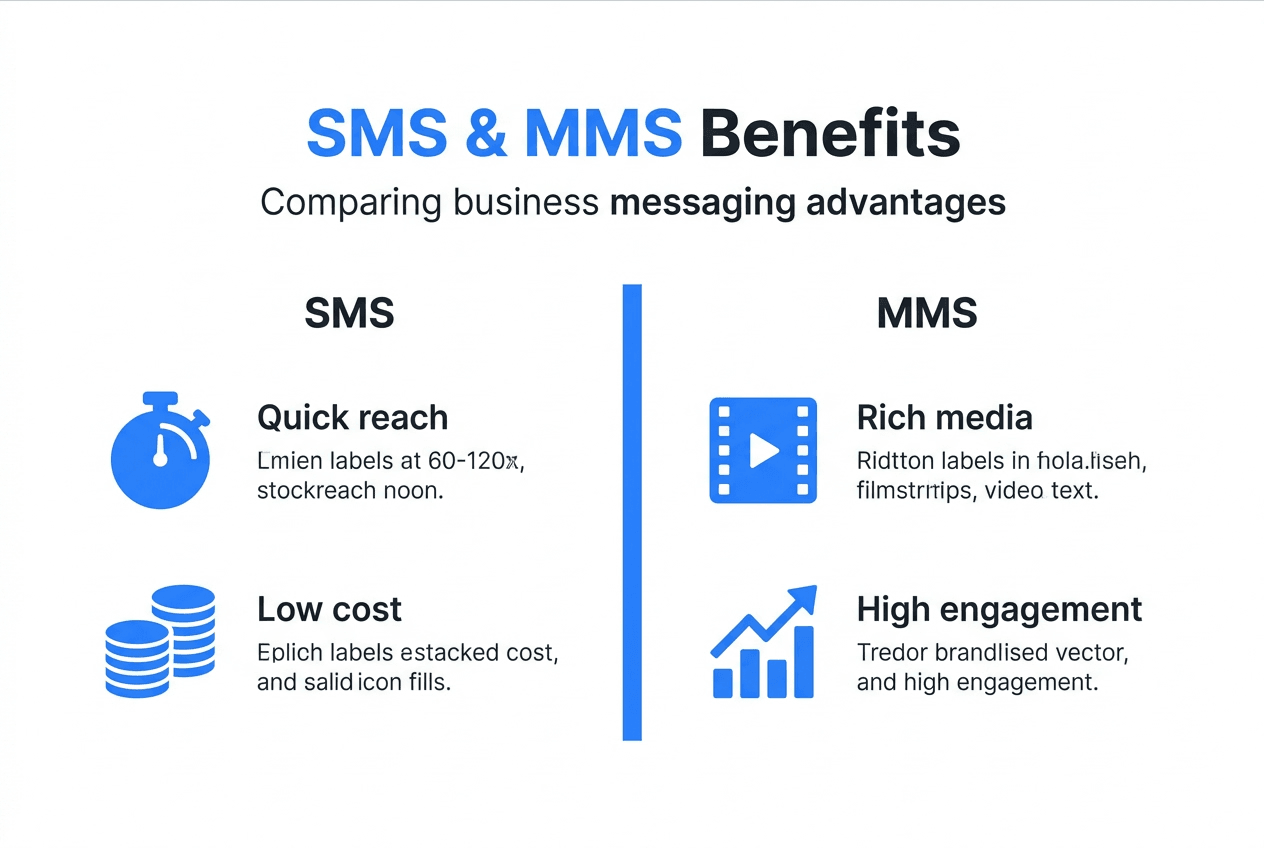
Text messaging achieves 98% open rates, dramatically outperforming email’s typical 20% rate. Messages get read within minutes, making SMS and MMS ideal for time-sensitive business communications.

Consumer behavior strongly favors texting. 84% of consumers opt in to receive SMS from businesses they trust, showing that customers actively want this communication channel when it provides value.
The preference runs deeper: 90% of people prefer text communication for quick interactions with businesses. Texting fits naturally into daily routines, requires no app downloads, and works on every mobile device.
Practical applications for SMBs include:
- Appointment scheduling and automated reminders that reduce no-shows by 30% or more
- Order confirmations and delivery updates that keep customers informed throughout the purchase journey
- Limited-time promotions that create urgency and drive immediate action
- Customer service responses that resolve simple questions without phone calls
- Payment reminders and invoice notifications that improve cash flow
- Feedback requests and satisfaction surveys that gather actionable insights
MMS takes these interactions further by adding visual elements. A restaurant can send a mouth-watering photo of daily specials. A retail store can showcase new arrivals with product images. A service provider can send before-and-after photos to demonstrate work quality.
The combination of high open rates and multimedia capabilities creates powerful opportunities for customer engagement. However, success requires strategic implementation rather than random message blasts.
Pro Tip: Segment your audience based on purchase history, preferences, or location. Send targeted messages that match each group’s interests rather than generic broadcasts. Personalized messaging generates 6 times higher transaction rates than mass messages.
Poor messaging strategy damages customer relationships. Sending too frequently, at inappropriate times, or with irrelevant content leads to opt-outs and negative brand perception. Start conservatively with one to two messages per month and increase frequency only if engagement metrics support it.
Role of SMS in business explores additional use cases and implementation strategies for integrating text messaging into your overall communication approach.
Compliance and best practices for SMS and MMS messaging in business
Federal regulations govern business text messaging to protect consumers from unwanted communications. The Telephone Consumer Protection Act (TCPA) prohibits unsolicited marketing texts and treats them with the same legal restrictions as unwanted phone calls.
The Federal Communications Commission (FCC) enforces regulations including extending the National Do Not Call Registry to SMS and issues substantial fines for violations. Penalties can reach $1,500 per message, making non-compliance extremely expensive.
Follow these essential compliance steps:
- Obtain explicit written consent before sending any marketing messages to customers
- Provide clear opt-out instructions in every message, typically using keywords like STOP or UNSUBSCRIBE
- Process opt-out requests immediately, within minutes rather than days
- Maintain detailed records of consent, including dates, times, and method of opt-in
- Register your business and messaging campaigns with The Campaign Registry (TCR)
- Include your business name in messages so recipients recognize the sender
The Campaign Registry verifies your brand reputation with mobile carriers and helps prevent message blocking. Unregistered businesses face increasing delivery problems as carriers tighten spam controls.
Best practices beyond legal requirements:
- Send messages during reasonable hours, typically 9 AM to 8 PM in the recipient’s time zone
- Limit frequency to avoid overwhelming customers, generally no more than 4 to 8 messages per month
- Provide genuine value in every message rather than constant sales pitches
- Use clear, concise language that respects the character limits and recipient’s time
- Test messages on multiple devices and carriers before sending to large audiences
- Monitor delivery rates, open rates, and opt-out rates to identify problems early
Consent requirements vary by message type. Transactional messages like order confirmations or appointment reminders require less stringent consent than promotional messages. However, you still need a business relationship and reasonable customer expectation of receiving such messages.
Double opt-in processes provide extra protection. After someone submits their phone number, send a confirmation message requiring them to reply YES or confirm their subscription. This creates clear documentation of consent.
Pro Tip: Create a messaging policy document that outlines your practices, consent procedures, and customer rights. Make this available on your website and reference it during the opt-in process for full transparency.
Violations damage more than your budget. Message blocking by carriers prevents your business communications from reaching customers at all. Reputation damage from spam complaints undermines customer trust and brand credibility.
Business messaging requirements provides comprehensive guidance on building compliant messaging programs that protect both your business and your customers.
Explore cloud communication solutions for your business
Modern SMS and MMS services work best when integrated into comprehensive cloud communication platforms. These systems connect texting, voice calls, video meetings, and collaboration tools into one seamless experience for your team and customers.
Benefits of cloud phone systems extend far beyond basic messaging. You gain unified communications that follow your team anywhere, advanced call routing that connects customers to the right person instantly, and analytics that reveal communication patterns and opportunities.
Voipcom specializes in helping Arizona and Colorado businesses transition from outdated phone systems to flexible, scalable cloud solutions. Our fully managed approach handles setup, integration, ongoing support, and compliance, so you can focus on running your business rather than managing technology.
Explore types of cloud phone systems to understand which architecture fits your business model, team size, and growth plans. Our local support team provides personalized guidance based on your specific needs and budget.
Ready to implement these communication tools? Our cloud phone system tutorial walks you through the setup process and shows how quickly you can start connecting with customers through their preferred channels.
FAQ
What is the character limit for SMS messages?
SMS messages have a 160-character limit for GSM-7 encoding, or 70 characters when using Unicode for special characters and emojis. Longer messages automatically segment into multiple parts, with each segment billed separately and reducing effective character limits to 153 per segment due to technical overhead.
How much does it cost to send MMS compared to SMS?
MMS typically costs 3 to 5 times more than SMS, with prices ranging from $0.03 to $0.10 per MMS message versus $0.01 to $0.03 for SMS. The higher cost reflects the multimedia content and increased data transfer requirements, making SMS more economical for simple text notifications while MMS justifies the expense when visual content significantly improves engagement.
What are the key compliance requirements for business SMS marketing?
Businesses must gain consumer opt-in, respect TCPA and FCC regulations, and ensure brand reputation via The Campaign Registry to comply with SMS marketing laws. You need explicit written consent before sending marketing texts, must provide clear opt-out mechanisms in every message, and should process unsubscribe requests immediately to avoid penalties of up to $1,500 per violation.
Can I use SMS and MMS together in my marketing strategy?
Yes, combining SMS and MMS creates a flexible communication strategy that balances cost and engagement. Use SMS for time-sensitive alerts, reminders, and simple notifications where text alone suffices. Reserve MMS for campaigns where visual content adds significant value, such as product launches, event promotions, or brand storytelling that benefits from images and videos.
What happens if my SMS message exceeds 160 characters?
Messages longer than 160 characters automatically split into multiple segments of 153 characters each, with technical headers consuming the difference. A 200-character message becomes two segments and costs twice as much. Most modern platforms reassemble segments seamlessly on the recipient’s device, but you pay for each segment sent.