

Growing healthcare practices in Arizona and Colorado often hit a wall when traditional phone systems cannot keep up with expanding teams or strict HIPAA requirements. Reliable communication technology matters when remote staff and patient safety are top priorities. With VoIP scalability, clinics and medical offices gain the power to add users, manage rising call volumes, and integrate security features without disrupting workflows or incurring excessive costs. This guide breaks down the essentials of scalable VoIP solutions for healthcare environments.
Table of Contents
- Defining VoIP Scalability for Business Growth
- Types of VoIP Scaling Solutions Compared
- How VoIP Supports Remote and Hybrid Teams
- HIPAA Compliance in VoIP Scalability
- Financial Impacts and Common Pitfalls
Key Takeaways
| Point | Details |
|---|---|
| VoIP Scalability Importance | VoIP scalability allows organizations to grow communication capabilities efficiently without performance loss or excessive costs. |
| Two Scaling Approaches | Businesses can utilize vertical scaling to enhance current systems or horizontal scaling to distribute loads across multiple instances. |
| Supporting Remote Teams | VoIP enhances collaboration for remote and hybrid teams by providing unified communication and cloud-based features. |
| Financial Considerations | Careful financial planning is essential to avoid pitfalls in scaling VoIP, including overestimating costs and underestimating future needs. |
Defining VoIP Scalability for Business Growth
In the rapidly evolving world of business communications, VoIP scalability represents a critical technological capability that enables organizations to grow efficiently. Scalability in technology systems directly correlates with an organization’s ability to expand communication infrastructure without sacrificing performance or incurring excessive costs.
Understanding VoIP scalability means recognizing how communication systems can dynamically adapt to changing business needs. The core promise of scalable VoIP solutions involves three primary dimensions:
- Effortless user addition without complex reconfiguration
- Seamless capacity expansion for call volumes
- Cost-effective integration of advanced communication features
Businesses in technology corridors like Denver and Phoenix require communication systems that can rapidly adjust to growth. Scalable technologies enable efficient expansion by allowing companies to incrementally increase resources without performance degradation. For medical practices and healthcare organizations, this means maintaining HIPAA compliance while supporting remote teams and expanding communication capabilities.
The practical implications of VoIP scalability extend beyond simple user addition. Modern businesses need communication platforms that can:
- Support distributed workforce models
- Integrate seamlessly with existing technology infrastructure
- Provide enterprise-grade security
- Enable real-time collaboration across geographic boundaries
Pro tip: Before selecting a VoIP system, always conduct a comprehensive assessment of your current and projected communication needs to ensure true scalability.
Types of VoIP Scaling Solutions Compared
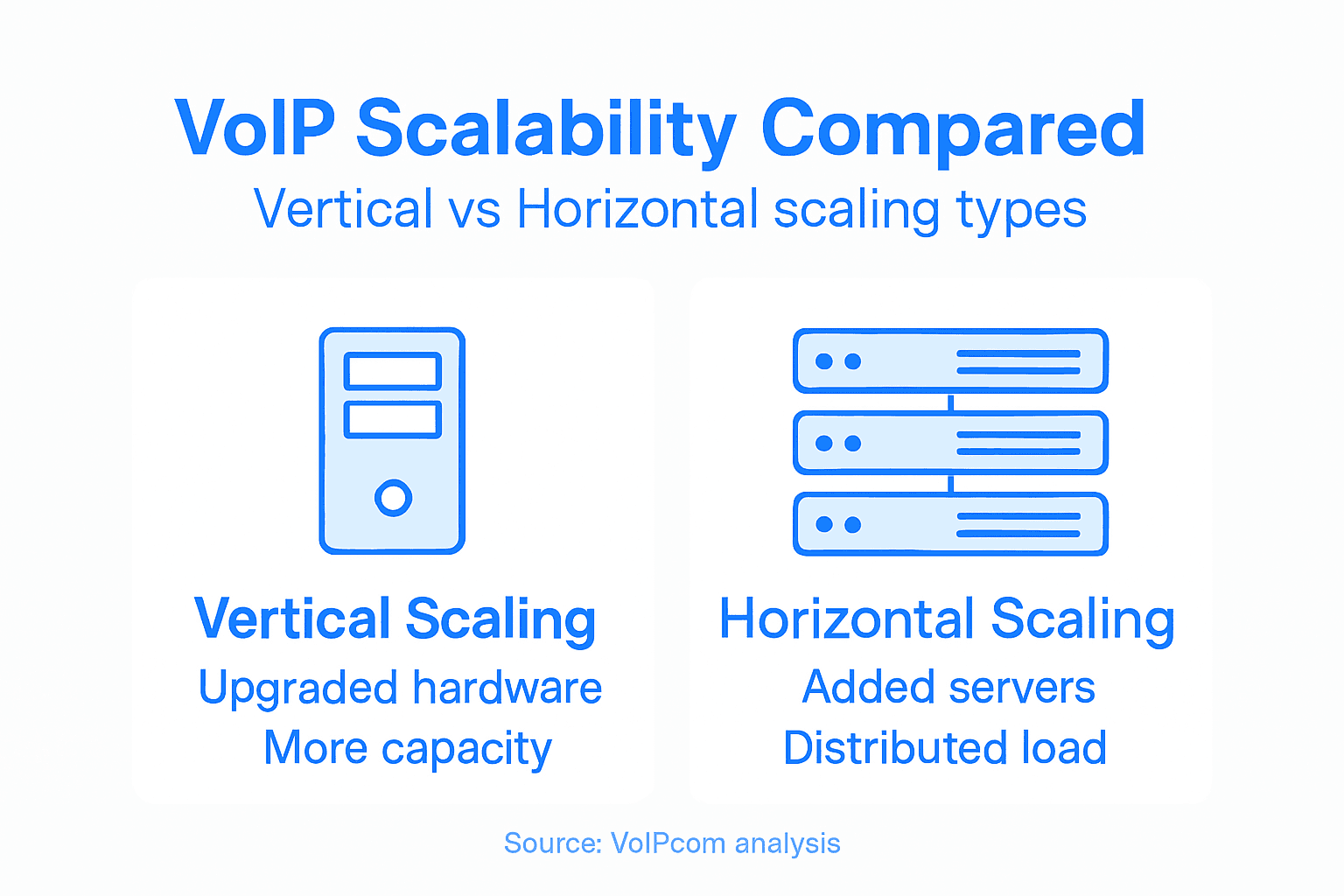
Business communication technologies require flexible scaling approaches to accommodate growing organizational needs. VoIP scaling solutions fundamentally fall into two primary categories: vertical and horizontal scaling, each offering unique advantages for expanding communication infrastructure.
Vertical Scaling involves enhancing existing hardware or software components to increase capacity. This approach typically includes:
- Upgrading server memory
- Increasing processor capabilities
- Expanding storage infrastructure
- Improving network bandwidth
In contrast, Horizontal Scaling distributes communication load across multiple servers or instances. VoIP platforms support various scaling strategies that enable businesses to handle growing communication demands efficiently. These strategies include:
- Adding multiple communication servers
- Implementing load balancing technologies
- Utilizing cloud-based infrastructure
- Supporting concurrent call management
Modern VoIP solutions leverage advanced protocols like SIP and H.323 to ensure interoperability and seamless scalability. Healthcare organizations and technology firms in regions like Denver and Phoenix can particularly benefit from these flexible scaling approaches, which allow rapid adaptation to changing communication requirements.

Here’s how vertical and horizontal VoIP scaling approaches compare for businesses:
| Aspect | Vertical Scaling | Horizontal Scaling |
|---|---|---|
| Infrastructure Change | Upgrade existing systems | Add new servers/instances |
| Cost Structure | Higher upfront cost | Pay as you grow |
| Downtime Risk | Potential system downtime | Minimal disruption |
| Adaptability | Limited long-term flexibility | Highly scalable solution |
| Best Use Case | Small growing organizations | Rapidly expanding companies |
Pro tip: Evaluate your organization’s communication growth trajectory before selecting a VoIP scaling solution to ensure optimal long-term performance and cost-effectiveness.
How VoIP Supports Remote and Hybrid Teams
Voice over Internet Protocol (VoIP) has revolutionized communication for distributed workforces, enabling seamless collaboration across diverse geographic locations. VoIP technology facilitates communication by transforming traditional communication barriers into flexible, interconnected work environments.
Modern remote and hybrid teams benefit from VoIP’s comprehensive communication features:
- Unified communication across multiple devices
- Crystal-clear audio and video conferencing
- Advanced call routing and forwarding
- Mobile app integration for smartphones and laptops
- Voicemail-to-email functionality
VoIP solutions offer cost-effective communication strategies that adapt to evolving workplace dynamics. Healthcare practices and technology firms in Denver and Phoenix can leverage these tools to maintain professional communication standards while supporting flexible work arrangements.
The cloud-based infrastructure of VoIP enables organizations to create robust communication networks that transcend physical office limitations. Key advantages include:
- Instant team collaboration
- Secure communication channels
- Scalable communication infrastructure
- Reduced telecommunications expenses
- Enhanced mobility for distributed teams
Pro tip: Conduct a comprehensive audit of your team’s communication needs before implementing a VoIP solution to ensure maximum compatibility and user adoption.
HIPAA Compliance in VoIP Scalability
HIPAA compliance represents a critical consideration for healthcare organizations implementing scalable communication technologies. Secure VoIP infrastructure requires comprehensive monitoring to protect sensitive patient information while maintaining flexible communication capabilities.
Healthcare providers must implement robust security measures that address potential vulnerabilities in VoIP systems:
- End-to-end encryption protocols
- Secure user authentication mechanisms
- Restricted access controls
- Comprehensive audit logging
- Regular security vulnerability assessments
HIPAA telephone rules mandate strict confidentiality standards for protecting patient health information during communication. Medical practices in Denver and Phoenix must ensure their VoIP solutions include advanced security features that prevent unauthorized data disclosure while supporting seamless scalability.
Key compliance strategies for healthcare organizations scaling VoIP infrastructure include:
- Implementing multi-factor authentication
- Conducting periodic security training
- Establishing clear communication policies
- Utilizing encryption for all voice transmissions
- Maintaining detailed access logs and records
Pro tip: Develop a comprehensive HIPAA compliance checklist specific to your VoIP communication infrastructure to proactively address potential security vulnerabilities.
Financial Impacts and Common Pitfalls
VoIP scalability presents complex financial considerations for businesses seeking to expand their communication infrastructure. Telecom sector investment analyses reveal nuanced challenges in balancing operational costs with technological expansion.
Common financial pitfalls in VoIP scaling include:
- Underestimating infrastructure investment requirements
- Overlooking bandwidth consumption costs
- Failing to predict future communication needs
- Neglecting potential performance degradation
- Insufficient budget for ongoing maintenance
VoIP network performance simulations highlight critical trade-offs between service quality and resource allocation. Healthcare practices and technology firms in Denver and Phoenix must carefully strategize their communication investments to avoid unexpected expenses.
Key financial strategies for managing VoIP scalability involve:
Key strategies help organizations manage financial risks when scaling VoIP:
| Strategy | Financial Impact | Business Benefit |
|---|---|---|
| Phased scaling | Reduces sudden large expenses | Allows better cash flow control |
| Infrastructure assessment | Avoids overinvestment | Ensures right-size solutions |
| Performance monitoring | Prevents costly outages | Maintains high service quality |
- Conducting comprehensive infrastructure assessments
- Implementing phased scaling approaches
- Developing precise budgetary forecasts
- Monitoring performance metrics continuously
- Maintaining flexible technological roadmaps
Pro tip: Create a detailed financial model that accounts for potential scaling scenarios and unexpected technology evolution to minimize budget overruns.
Unlock Seamless VoIP Scalability with Voipcom
Growing businesses face unique communication challenges as they scale. The article highlights the importance of flexible VoIP solutions that adapt effortlessly to fluctuating user demands, call volumes, and remote workforce needs all while maintaining cost efficiency and security. If you are overwhelmed by complex system upgrades or worried about keeping your infrastructure compliant and reliable, you are not alone.
Voipcom understands these pain points and offers cloud-based hosted PBX services designed specifically for businesses in Arizona and Colorado aiming for scalable communication. Our solutions remove the hassle of costly reconfigurations or downtime through transparent pricing, local managed support, and cutting-edge features like mobile app soft-phones and AI-powered calling.
Take control of your communication growth today with a provider that makes scalability simple and secure. Explore Voipcom’s flexible phone systems that empower your business to add users instantly, integrate fully with Microsoft Teams, and support remote teams without risking HIPAA compliance or performance setbacks.

Act now to replace your legacy phone system with a modern, scalable VoIP platform that scales as your business does. Visit Voipcom to schedule your personalized consultation and experience locally supported, fully managed VoIP solutions tailored for your unique needs.
Frequently Asked Questions
What is VoIP scalability?
VoIP scalability refers to the ability of Voice over Internet Protocol systems to adapt and grow along with changing organizational communication needs without compromising performance or excessively increasing costs.
Why is scalability important for businesses using VoIP?
Scalability is crucial for businesses as it allows for effortless user addition, seamless capacity expansion for call volumes, and cost-effective integration of advanced communication features, enabling organizations to efficiently respond to growth.
What are the types of scaling solutions available for VoIP?
The two main types of VoIP scaling solutions are vertical scaling, which involves upgrading existing hardware or software, and horizontal scaling, which distributes the communication load across multiple servers, allowing for flexible expansion.
How does VoIP scalability support remote and hybrid teams?
VoIP scalability supports remote and hybrid teams by providing unified communication features, such as flexible collaboration tools and secure communication channels, that enhance team connectivity and productivity regardless of geographic location.
Recommended
- 5 Reasons Why VoIP Beats Traditional Landline Phones for Business Communication – Voipcom
- Voice Over IP Basics for Modern Business Success – Voipcom
- The Impact of VoIP on Remote Work: A Comprehensive Analysis – Voipcom
- 7 Must-Have VoIP Features for Business Success – Voipcom
- 7 Beispiele flexibler Bürolösungen für KMU und Startups | ProOffice Business Center Blog