

Every Arizona and Colorado healthcare practice relies on clear, confidential phone conversations, but misconceptions about VoIP often spark unnecessary worry. Many teams believe internet-based phones are a security gamble, when in reality, VoIP systems are only as secure as the protections you put in place. With threats ranging from eavesdropping to DDoS attacks, understanding what truly matters—and spotting common myths—helps you keep patient data safe while meeting HIPAA standards.
Table of Contents
- VoIP Security Basics And Common Myths
- Types Of VoIP Attacks And Vulnerabilities
- Key Security Protocols For HIPAA Compliance
- Risks, Costs, And SMB Legal Exposure
- Best Practices For Securing VoIP Systems
Key Takeaways
| Point | Details |
|---|---|
| VoIP Security is Manageable | With the right controls like encryption and firewalls, VoIP systems can be as secure, if not more secure, than traditional landlines. |
| Myths vs. Reality | Many misconceptions surround VoIP security; implementing strong security measures effectively reduces risks. |
| Comprehensive HIPAA Compliance | Healthcare practices must ensure VoIP systems meet encryption and security best practices to comply with HIPAA regulations. |
| Employee Training is Essential | Regular training on recognizing threats and safe practices is critical to minimizing vulnerabilities in any VoIP system. |
VoIP security basics and common myths
Many healthcare SMBs in Denver and Phoenix assume VoIP is inherently risky because calls travel over the internet. That’s not quite accurate. VoIP systems are only as secure as the infrastructure protecting them—just like your patient data isn’t automatically vulnerable because you use computers.
Let’s break down what actually matters and what’s mostly fear.
Here’s a comparison of traditional phone security versus modern VoIP security:
| Category | Traditional Landlines | Modern VoIP Systems |
|---|---|---|
| Main Threats | Physical tampering, wiretapping | Network attacks, eavesdropping, DDoS |
| Security Control | Relies on physical access | Uses encryption and authentication |
| Breach Detection | Slow, often undetected | Real-time network monitoring |
| Upgrade Potential | Limited by infrastructure | Easily improved with software updates |
Understanding Real VoIP Threats
VoIP faces specific security challenges that differ from traditional phone systems. Internet-based VoIP systems encounter risks like caller ID spoofing, eavesdropping, and DDoS attacks that hardwired phones simply don’t face.
Here are the actual threats you should understand:
- Caller ID spoofing: Someone disguises their identity to make calls appear legitimate. A patient thinks they’re calling your Phoenix office but it’s actually a scammer.
- Eavesdropping: Unencrypted calls can be intercepted over your network, exposing sensitive patient information.
- DDoS attacks: Attackers flood your VoIP system with traffic, making it unavailable when you need it.
- Toll fraud: Unauthorized users access your system and make expensive long-distance calls.
- Malware: Infected devices on your network can compromise your phone system.
These threats are real. But they’re all preventable.
The Myths Holding You Back
Myth 1: “VoIP is inherently less secure than landlines.”
Landlines rely on physical infrastructure, which is why traditional phones face fewer cyber threats. But that’s their only advantage. Modern VoIP systems with proper encryption and firewalls outperform landlines when it comes to overall security controls.
Myth 2: “If I upgrade to VoIP, my calls will be hacked.”
This assumes zero security measures. With encryption, network protection, and proper access controls, VoIP calls are actually quite difficult to intercept. Healthcare practices across the Denver Tech Center and Scottsdale are successfully protecting HIPAA-sensitive conversations right now.
Myth 3: “Encryption slows down my calls.”
Modern encryption has minimal performance impact. You won’t notice call delays with proper infrastructure.
Myth 4: “I need to worry about VoIP more than everything else.”
This is partially true—but not in the way you think. VoIP is one vulnerability among many. A practice without email security, backup internet, or network firewalls has much bigger problems than their phone system. VoIP security works best as part of a larger strategy.
The real risk isn’t VoIP itself—it’s neglecting basic protections like encryption, firewalls, and network monitoring across your entire operation.
What Actually Protects Your VoIP System
These controls matter:
- Encryption: Makes calls unreadable to anyone who intercepts them.
- Firewalls: Blocks unauthorized access to your phone system.
- Strong authentication: Prevents unauthorized users from accessing your VoIP account.
- Network monitoring: Detects unusual activity before it becomes a problem.
- Regular updates: Patches vulnerabilities as they’re discovered.
Voipcom handles these protections as part of our fully managed service. You don’t need to hire a dedicated security team for your phone system.
Pro tip: Ask your VoIP provider specifically how they encrypt your calls, monitor for threats, and handle DDoS attacks—vague answers suggest they haven’t thought this through.
Types of VoIP attacks and vulnerabilities
VoIP attacks come in many flavors, and understanding them helps you recognize what you’re actually protecting against. Unlike physical phone systems, VoIP vulnerabilities exist at multiple layers—from the devices themselves to the networks carrying your calls.
Let’s walk through the attacks healthcare practices in Denver and Phoenix actually need to worry about.
Hardware and Device Vulnerabilities
Your VoIP phones are computers. That means they can be hacked like computers. Remote attackers can gain root-level access to certain phone models through buffer overflow exploits, allowing them to intercept calls by redirecting traffic through malicious proxies.
This sounds scary, but it’s actually manageable:
- Keep phone firmware updated as patches are released
- Use phones from vendors with strong security track records
- Isolate VoIP devices on a separate network segment when possible
- Monitor for unusual device behavior or unexpected updates
The key is staying current. Most hospitals and practices never experience hardware-level attacks because they update their equipment.
Network-Layer Attacks
These attacks target the infrastructure carrying your calls, not the phones themselves. Man-in-the-middle attacks intercept communications between your phone and the VoIP server, allowing attackers to listen to conversations or even modify call routing.
Common network attacks include:
- SIP flooding: Attackers overwhelm your system with fake call requests, making it unavailable (similar to DDoS).
- Eavesdropping: Unencrypted traffic is captured and played back later.
- Session hijacking: An attacker takes over an active call mid-conversation.
- Registration hijacking: Someone registers a fake device using legitimate credentials.
Firewalls and encryption stop most of these before they cause damage.
Social Engineering and Vishing
Attackers often skip technical exploits entirely. Instead, they call your staff pretending to be IT support, a vendor, or a patient, then trick someone into revealing credentials or system access.
This is arguably the easiest attack to execute and the hardest to prevent technically. Training matters more than firewalls here.
The weakest link in any VoIP system is still human behavior. No encryption stops someone from telling an attacker their password.
Toll Fraud and Account Takeover
If someone gains access to your VoIP credentials, they can make expensive international calls on your dime or redirect incoming calls to their own system. A single compromised password can cost hundreds or thousands in unauthorized usage.
This happens when credentials are weak, shared across multiple people, or reused from breached websites elsewhere.
Why This Matters for Healthcare Practices
For medical and dental offices, the biggest risk isn’t just the attack itself. It’s the data exposed. A call between a dentist and an insurance company discussing a patient’s treatment plan is protected health information. Eavesdropping on that call violates HIPAA and exposes your practice to liability.
Voipcom’s encryption and network monitoring detect and prevent these attacks automatically, so your staff can focus on patient care instead of worrying about call security.
Pro tip: Require strong, unique passwords for VoIP accounts and change them quarterly—this single practice prevents the majority of account takeovers.
Key security protocols for HIPAA compliance
HIPAA compliance isn’t optional for healthcare practices. It’s the law. But here’s what many dental and medical offices don’t realize: compliance isn’t just about checking boxes. It’s about actually protecting patient conversations and data from real threats.
The U.S. Department of Health and Human Services recently updated HIPAA requirements to address modern cybersecurity risks. Let’s cover what matters most for your practice.
Encryption: The Foundation
Encryption turns patient conversations into unreadable gibberish if someone intercepts them. This is non-negotiable. All calls carrying protected health information must be encrypted end-to-end, from your phone to the VoIP server and everywhere in between.
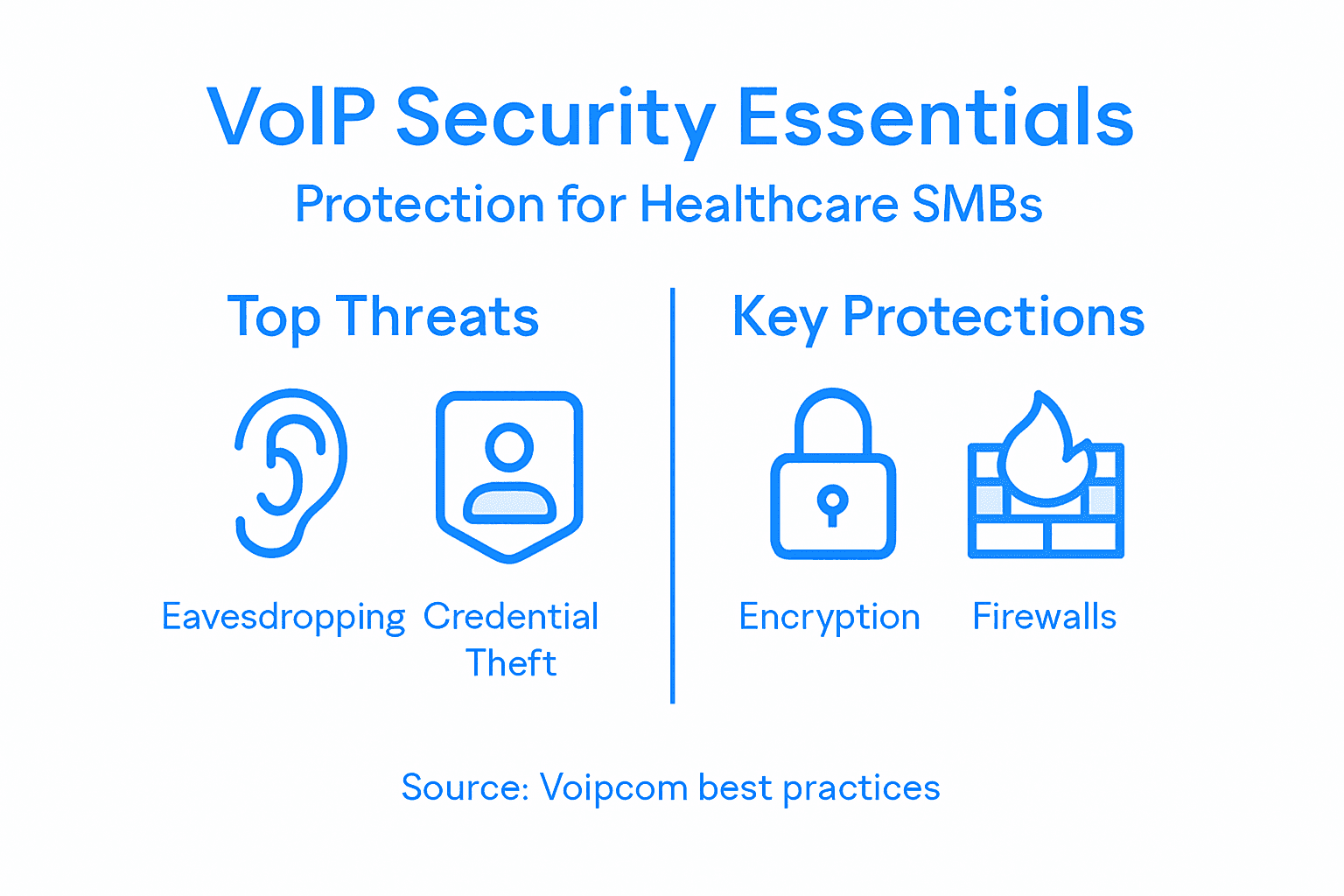
Technical safeguards like encryption of protected health information are now mandatory, not optional. Voipcom handles this automatically with industry-standard encryption protocols on all lines.
Without encryption, your practice is violating HIPAA the moment a call is made.
Below is a summary of HIPAA-related VoIP security responsibilities that often surprise healthcare practices:
| HIPAA Compliance Area | What Is Required | Commonly Overlooked |
|---|---|---|
| Encryption | End-to-end for all calls | Unencrypted internal calls |
| Access Controls | MFA, strong passwords | Local device logins |
| Risk Assessment | Annual vulnerability testing | Documenting every device |
| Incident Response | Written breach procedures | Notifying all vendors quickly |
Multi-Factor Authentication and Access Controls
Someone can’t steal what they can’t access. Multi-factor authentication (MFA) requires two forms of verification before anyone can log into your VoIP system—like a password plus a code sent to their phone.
This stops account takeovers cold:
- Require MFA for all staff accessing VoIP administration
- Use strong, unique passwords that change quarterly
- Limit admin access to only those who need it
- Audit login attempts monthly for suspicious activity
Weak passwords are how most healthcare breaches start. Not fancy hacking. Just someone guessing a simple password.
Risk Analysis and Vulnerability Testing
You can’t protect what you don’t understand. Detailed risk analysis and vulnerability testing are now mandatory under updated HIPAA rules. This means documenting every device on your network, every vulnerability, and every weakness.
For small practices, this sounds overwhelming. Voipcom handles this as part of our managed service. We conduct annual audits, test for vulnerabilities, and maintain documentation proving your compliance.
Network Segmentation and Firewalls
Your VoIP system shouldn’t live on the same network as patient computers, printers, or wifi guest access. Network segmentation isolates your phone system so that even if someone hacks a workstation, they can’t reach your calls.
Add a firewall that blocks unauthorized traffic, monitors for suspicious activity, and logs everything for audit purposes.
Incident Response Plans
Something will eventually go wrong. A breach attempt. A compromised device. A confused employee clicking a phishing link. What matters is how fast you respond.
You need a written incident response plan that covers:
- Who to contact if a breach occurs
- How to isolate affected systems
- Documentation and notification procedures
- Recovery steps
HIPAA penalties for breaches now exceed $100 per patient record. A breach affecting 500 patients costs $50,000 minimum—even for small practices.
Annual Audits and Documentation
Compliance requires proof. Keep detailed records of:
- Security updates and patches applied
- Access logs and authentication attempts
- Incident response actions taken
- Staff training completion dates
- Risk assessment results
Voipcom maintains this documentation automatically, so you’re always audit-ready.
Pro tip: Schedule compliance audits in January or February before tax season consumes your attention, ensuring you’re never scrambling at year-end.
Risks, costs, and SMB legal exposure
Here’s what keeps most healthcare practice owners awake at night: a data breach doesn’t just cost money in the moment. It creates cascading legal liability that can destroy a small practice financially.
Let’s talk about what’s actually at stake when VoIP security fails.
The Financial Impact of a Breach
A single HIPAA breach is expensive. The costs go far beyond the fine itself. When patient data is exposed through your phone system, you’re facing:
- Regulatory fines up to $1.5 million per violation category annually
- Notification costs (mailing letters to affected patients)
- Credit monitoring services for patients
- Legal fees for investigation and defense
- Lost patient trust and referrals
- Reputational damage that lasts years
A practice that experiences a breach affecting 500 patients easily spends $50,000 to $250,000 just on notification and remediation. That’s before fines.
Who’s Actually Liable?
Here’s the part many practice owners don’t understand: you are liable even if you outsource your VoIP system. Physicians bear legal liability under HIPAA even when using third-party vendors. You can’t simply blame your phone provider and walk away.
This is critical. If your VoIP vendor gets hacked and patient conversations are exposed, the liability flows to you as the practice owner. You’re responsible for vetting vendors, ensuring they maintain proper security, and documenting that oversight.
Understanding Your Risk Exposure
Financial and legal exposure for SMBs increases dramatically when unaddressed vulnerabilities exist in systems handling protected health information. The gap between having a vulnerability and having it exploited is where your exposure lives.
A vulnerability is a weakness. A threat is someone trying to exploit it. Risk is what happens when they succeed. Most practices ignore vulnerabilities assuming they’ll never be targeted. That’s gambling with patient data.
The Types of Exposure You Face
Breach liability falls into several categories:
- Regulatory fines: HHS enforces HIPAA with substantial penalties
- Class action lawsuits: Patients can sue if their data is exposed
- Business interruption: Your practice can’t function without phones during a breach investigation
- Reputation damage: News of a breach spreads through patient networks immediately
- Insurance gaps: Many general liability policies don’t cover cybersecurity breaches
Vendor Accountability Matters
You can reduce liability by choosing vendors who take security seriously. Ask your VoIP provider to document:
- HIPAA compliance certifications
- Regular security audits and penetration testing
- Incident response procedures
- Data encryption protocols
- Business continuity plans
Voipcom provides all of this documentation as standard. We conduct annual audits, maintain encryption, and have incident response plans ready.
Choosing a VoIP provider isn’t just a cost decision—it’s a legal and liability decision that directly impacts your practice’s future.
What Happens in a Real Breach
A breach investigation takes weeks to months. During that time, you’re documenting everything, notifying regulators, and potentially facing angry patients. Your staff is distracted from patient care. Revenue drops.
The difference between a contained breach and a catastrophic one often comes down to whether you caught it fast. That requires monitoring, logging, and rapid response capabilities.
Pro tip: Document every vendor conversation about security in writing—emails confirming their compliance protocols create a paper trail proving you exercised due diligence when regulators investigate.
Best practices for securing VoIP systems
Securing a VoIP system isn’t complicated, but it does require intentional planning. The good news: most breaches happen because organizations skip basic practices, not because attackers are unstoppable geniuses.
If you implement these fundamentals, you’re ahead of 80% of healthcare practices.
Network Segmentation First
Network segmentation means isolating your VoIP phones on a separate network from everything else. Your patient computers, printers, wifi guest network, and office laptops should all live in different network zones.
Why? If someone hacks a workstation, they can’t reach your phones. If your phones get compromised, they can’t access patient data stored on computers. Think of it like having separate locked doors instead of one shared hallway.
Implement this by:
- Creating a dedicated VLAN (virtual network) for VoIP devices
- Restricting traffic between network zones with firewalls
- Monitoring traffic for unusual patterns
- Testing segmentation quarterly
This single step stops most lateral attacks cold.
Encryption for All Traffic
Comprehensive requirements for securing VoIP systems include strong encryption, secure authentication, and regular software patching. Encryption turns your calls into unreadable data if intercepted.
This must happen at two levels:
- Transport encryption: Protects calls traveling between your phone and the VoIP server
- End-to-end encryption: Protects calls between two phones on your system
Voipcom uses industry-standard encryption protocols on all calls automatically. You don’t need to configure this yourself.
Multi-Factor Authentication and Access Control
Someone can’t steal credentials they don’t have. Multi-factor authentication (MFA) requires two forms of proof before anyone accesses your VoIP system.
Required for:
- All admin accounts
- Remote access to the system
- Anyone managing phone settings or users
Pair MFA with strong password policies: minimum 12 characters, changed quarterly, never reused.
Regular Updates and Patching
Vulnerabilities in phone hardware or VoIP software get discovered constantly. Vendors release patches within days or weeks. Most practices ignore patches for months or years.
That’s the window where attackers operate. Set automatic updates on your phones and VoIP server. Test patches on one device first, then roll out to the rest.
Voipcom handles patching automatically as part of our managed service.
Physical Security Matters
Someone with physical access to a phone can extract data or install malware. Your server room should be locked. Visitor access should be restricted and logged.
Staff shouldn’t leave phones unattended in public areas. Retired phones should be securely wiped before disposal.
Employee Training
Healthcare cybersecurity guidance emphasizes employee training as essential to protecting VoIP systems. Your staff are the gatekeepers. Train them to:
- Recognize vishing attacks (social engineering calls)
- Never share credentials via email or phone
- Report suspicious activity immediately
- Use strong passwords
- Lock computers when stepping away
One confused employee clicking a phishing link can compromise your entire system.
Monitoring and Incident Response
You can’t protect what you don’t see. Deploy monitoring that logs:
- All login attempts
- Call recordings (for audit purposes)
- Network traffic anomalies
- Device configuration changes
Review logs monthly for red flags. Have an incident response plan ready before something happens.
The difference between contained breaches and catastrophic ones is detecting the problem in the first 24 hours. That requires active monitoring, not just passive systems.
Pro tip: Schedule security reviews quarterly with your IT team or managed provider—align them with seasonal changes so updates happen during slower business periods, not during patient surge times.
Protect Your Healthcare Practice with Secure, Modern VoIP Solutions
The article clearly highlights the critical need for healthcare SMBs to secure their VoIP systems against real threats like caller ID spoofing, eavesdropping, and toll fraud. Your practice deserves more than outdated phone systems vulnerable to costly HIPAA breaches and legal exposure. The key pain points include ensuring encryption, strong authentication, network monitoring, and compliance with HIPAA standards to safeguard sensitive patient communications.
Voipcom offers fully managed, cloud-based phone systems designed for healthcare providers in Arizona and Colorado. Our solutions combine robust cybersecurity features such as end-to-end encryption, multi-factor authentication, and continuous vulnerability management with seamless integration into your daily workflow. Remove the worry about network attacks and compliance headaches by partnering with a trusted provider focused on security and simplicity.
Take control of your practice’s communications now and protect patient data with confidence.
Secure your phones today with Voipcom’s healthcare-focused VoIP service
Ready to lower your risk of costly breaches and improve your communication reliability? Explore how our voice and telephony services provide industry-leading security and ease of use. Contact us to receive personalized recommendations tailored to your practice’s unique needs. Don’t wait until a breach happens when a simple call can secure your entire phone system. Start your Voipcom experience at Voipcom and protect your patients’ trust today.
Frequently Asked Questions
What are the primary security threats to VoIP systems in healthcare?
VoIP systems in healthcare face specific threats such as caller ID spoofing, eavesdropping on unencrypted calls, DDoS attacks, toll fraud, and malware attacks on network devices.
How can healthcare SMBs ensure the security of their VoIP communications?
Healthcare SMBs can enhance VoIP security by implementing encryption, strong authentication practices, regular software updates, firewalls, and network monitoring. These measures can help prevent unauthorized access and data breaches.
Is VoIP more secure than traditional landlines for healthcare practices?
Modern VoIP systems, when secured properly with encryption and firewalls, can offer better overall security than traditional landlines, which rely on physical infrastructure vulnerable to tampering but face fewer cyber threats.
What are the HIPAA compliance requirements for VoIP systems in healthcare?
HIPAA compliance for VoIP systems includes ensuring end-to-end encryption of calls containing protected health information, implementing strong access controls, conducting risk assessments, having incident response plans, and maintaining thorough documentation of security practices.