


Over half of American businesses now rely on VoIP solutions to power their remote teams. Reliable communication is no longer confined to the office as technology bridges distance and transforms how people work. With features tailored for flexibility, security, and seamless integration, VoIP platforms offer a smarter way for professionals to stay connected no matter where they are based.
Key Takeaways
| Point | Details |
|---|---|
| VoIP Technology Enhances Remote Work | Voice over Internet Protocol enables seamless communication, mobile flexibility, and advanced features that traditional systems lack, boosting productivity for remote teams. |
| Integration with Business Tools | VoIP systems seamlessly integrate with platforms like CRMs and collaboration tools, enhancing workflows and ensuring effective communication across various applications. |
| Cost Savings Over Legacy Systems | Transitioning to VoIP can save businesses 30% to 50% on communication costs compared to legacy systems, reducing both setup and maintenance expenses. |
| Security and Compliance Are Crucial | With increased cyber threats, businesses must adopt multi-layered security protocols for their VoIP systems to protect sensitive communications and adhere to regulations. |
VoIP Technology and Its Remote Work Benefits
The Silicon Mountain and Silicon Desert are witnessing an explosive transformation in business communications, with Voice over Internet Protocol (VoIP) emerging as the backbone of modern remote work strategies. VoIP technology transcends traditional phone systems by enabling businesses to communicate seamlessly across geographical boundaries, making location irrelevant and productivity paramount.
Voipcom delivers business VoIP in Denver, CO and Phoenix business phone systems from local offices. For the rest of the stack, see cloud phone service for Phoenix and Denver businesses.
At its core, VoIP converts voice signals into digital data packets transmitted over internet networks, allowing professionals in Denver’s Tech Center and Phoenix’s Warehouse District to connect as if they were in the same room. Remote work phone solutions have revolutionized how teams collaborate, offering features that traditional landlines could never match:
- Mobile Flexibility: Softphone applications that transform smartphones into business communication centers
- Cost Efficiency: Eliminating expensive long-distance charges and hardware maintenance
- Advanced Call Routing: Intelligent systems that route calls to the right team member instantly
- Integration Capabilities: Seamless connections with tools like Microsoft Teams and Zoho CRM
The real magic of VoIP lies in its ability to create a unified communication ecosystem. Whether you’re a legal professional in LoDo or an insurance broker in Old Town Scottsdale, these systems ensure you remain connected, productive, and responsive. The technology adapts to your workflow, not vice versa.
Pro Business Communication Tip: Configure your VoIP system with intelligent call forwarding and voicemail-to-email features to ensure you never miss a critical communication, even when working remotely.
Key Features Supporting Distributed Teams
In the evolving landscape of remote work, Voice over IP (VoIP) technologies have become critical infrastructure for distributed teams. These advanced communication systems provide far more than simple voice transmission, offering robust features that transform how professionals collaborate across different locations and time zones.
Real-time collaboration capabilities enable teams to maintain seamless connections, with sophisticated tools that bridge geographical gaps. These features include:
- Presence Indicators: Instant visibility into team member availability
- Unified Communication Platforms: Integrating voice, video, messaging, and file sharing
- Advanced Call Routing: Intelligent systems directing communications efficiently
- Mobile Softphone Applications: Transforming smartphones into professional communication hubs
Beyond basic communication, modern VoIP systems provide sophisticated analytics and reporting tools that help managers track team performance, communication patterns, and overall productivity. By offering granular insights into call volumes, response times, and interaction metrics, these platforms empower organizations to optimize their remote work strategies.

The technology particularly shines in supporting hybrid and distributed teams across regions like Denver’s Tech Center and Phoenix’s business corridors. By providing consistent, high-quality communication infrastructure, VoIP ensures that geographic distance becomes irrelevant to collaborative potential.
Pro Remote Work Communication Tip: Configure your VoIP system’s mobile app with specific notification settings to maintain professional boundaries while staying connected, ensuring you’re accessible without being constantly interrupted.
Integrating VoIP With Business Tools
The modern business landscape demands seamless communication technologies that integrate effortlessly with existing workflows. Voice over IP (VoIP) systems have evolved far beyond simple telephony, transforming into sophisticated platforms that connect and enhance a wide range of business productivity tools.
Remote employee onboarding and training programs now leverage advanced VoIP capabilities to create immersive collaborative experiences. These integrations typically encompass multiple professional ecosystems:
- Customer Relationship Management (CRM) Integration: Automatic call logging and customer interaction tracking
- Microsoft Teams and Slack Connections: Direct voice and video communication within collaboration platforms
- Salesforce and Zoho Synchronization: Click-to-dial functionality and real-time contact information
- Google Workspace and Office 365 Compatibility: Unified communication across productivity suites
The power of VoIP lies in its ability to transform disparate communication tools into a cohesive, intelligent network. By connecting voice systems with project management, customer service, and sales platforms, businesses can create more responsive and data-driven communication strategies.
The following table summarizes major VoIP integration types and their workflow advantages:
| Integration Type | Example Platforms | Workflow Advantage |
|---|---|---|
| CRM Integration | Salesforce, Zoho | Track calls within customer records |
| Collaboration Tools | Teams, Slack | Start calls from chats instantly |
| Productivity Suites | Google, Office 365 | Unified email, call, and calendar |
| Analytics & Reporting | Built-in dashboards | Monitor team performance metrics |
Particularly in tech-forward regions like Denver’s Silicon Mountain and Phoenix’s Silicon Desert, these integrations are becoming mission-critical for competitive organizations. The ability to seamlessly transition between communication channels while maintaining context and productivity represents the next frontier of business communication technology.
Pro Integration Tip: Conduct a comprehensive audit of your existing business tools before VoIP implementation, identifying key integration points and potential workflow improvements to maximize your communication infrastructure’s potential.
Security And Compliance For Remote Communications
In the rapidly evolving digital workplace, Voice over IP (VoIP) technologies must balance seamless communication with robust security protocols. The shift to remote work has exponentially increased cybersecurity vulnerabilities, demanding sophisticated defense mechanisms that protect sensitive business communications.
Security vulnerabilities in VoIP networks require comprehensive strategies that go beyond traditional firewall protections. Modern organizations must implement multi-layered security approaches that address potential risks:
- Encryption Protocols: End-to-end voice and data encryption
- Multi-Factor Authentication: Preventing unauthorized system access
- Network Segmentation: Isolating communication channels
- Real-Time Threat Monitoring: Continuous security assessment
- Compliance Management: Ensuring adherence to industry regulations
Specifically for regions like Denver and Phoenix, where technology and professional services converge, maintaining HIPAA, PCI-DSS, and other regulatory standards is paramount. VoIP systems must provide granular control mechanisms that allow businesses to demonstrate compliance while maintaining operational flexibility.
The cybersecurity landscape continues to evolve, with remote work introducing unprecedented communication challenges. By selecting VoIP solutions that prioritize security, businesses can create resilient communication infrastructures that protect both organizational and client data.
Pro Security Tip: Conduct quarterly comprehensive security audits of your VoIP infrastructure, including penetration testing and vulnerability assessments, to proactively identify and mitigate potential communication security risks.
Cost Efficiency Versus Legacy Phone Systems
Businesses in Denver’s Tech Center and Phoenix’s innovative corridors are rapidly discovering the substantial financial advantages of Voice over IP (VoIP) technologies over traditional landline communication systems. Legacy phone infrastructures represent an antiquated approach that burdens organizations with unnecessary expenses and operational limitations.
VoIP versus legacy phone systems reveal significant cost-saving opportunities across multiple dimensions:
- Hardware Costs: Elimination of expensive physical phone system installations
- Maintenance Expenses: Reduced technical support and equipment replacement fees
- Scalability: Instant user additions without complex infrastructure changes
- International Call Rates: Dramatically lower per-minute communication expenses
- Infrastructure Consolidation: Combining voice, data, and communication platforms
Modern VoIP solutions provide businesses with predictable monthly expenses, unlike legacy systems that require substantial upfront investments and ongoing maintenance contracts. Small to medium-sized businesses can save between 30% to 50% on communication infrastructure by transitioning to cloud-based phone systems, transforming technology from a cost center to a strategic asset.
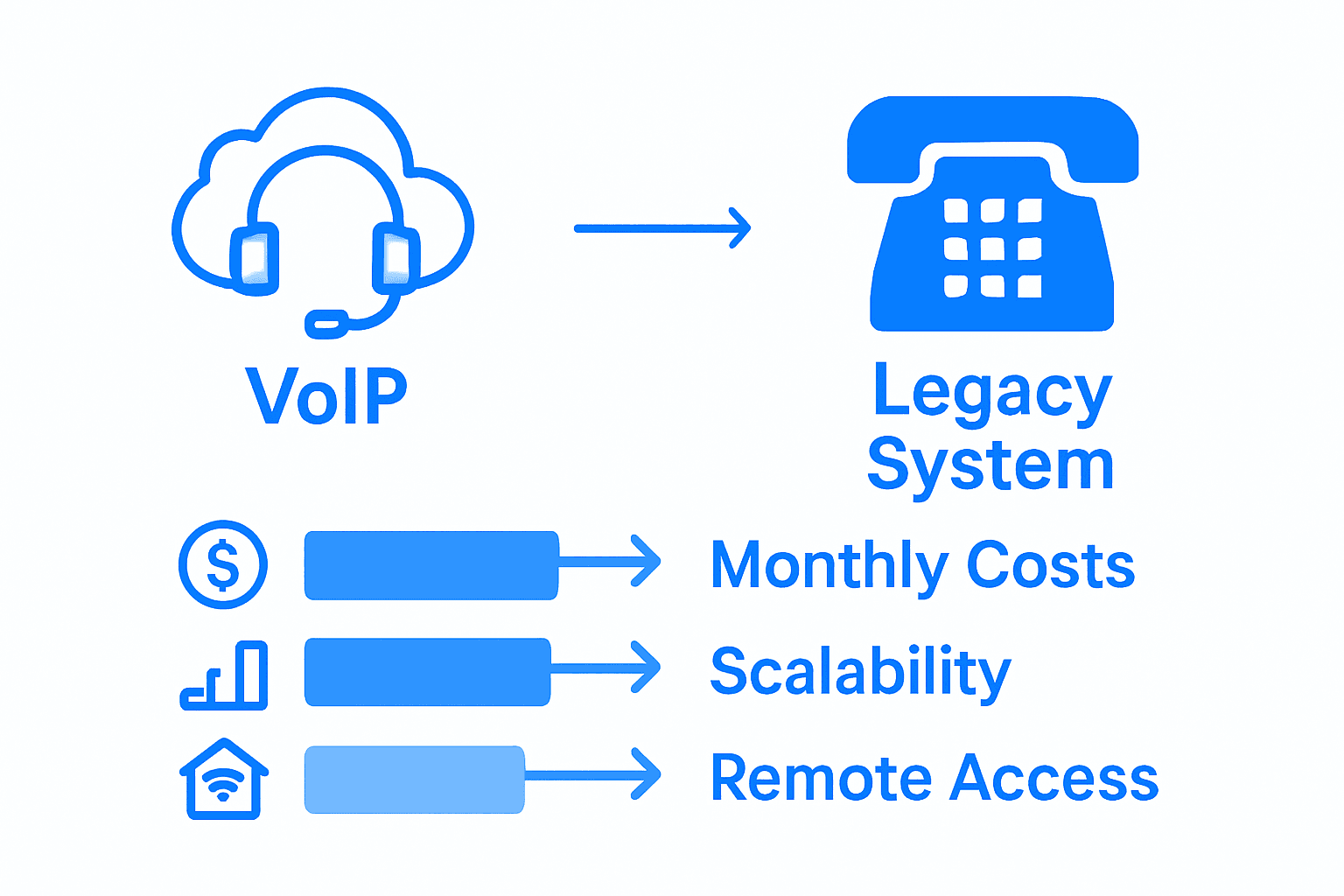
Here’s a comparison of key business benefits of VoIP versus legacy phone systems:
| Aspect | VoIP Systems | Legacy Phone Systems |
|---|---|---|
| Setup Costs | Minimal, often no hardware required | High, extensive physical setup |
| Scalability | Instantly add or remove users | Time-consuming, hardware changes |
| Monthly Expenses | Predictable, often flat-rate | Variable, many hidden fees |
| Collaboration Tools | Integrated video and chat options | Limited to voice calls only |
| Remote Accessibility | Anywhere with internet access | Typically location-dependent |
In tech-forward regions like Arizona and Colorado, where business agility is paramount, VoIP represents more than a communication tool. It’s a competitive advantage that enables organizations to adapt quickly, reduce operational overhead, and invest resources into core business growth strategies.
Pro Cost Management Tip: Conduct a comprehensive telecommunication audit to identify hidden expenses in your current phone system, then compare those costs against potential VoIP solutions to understand your precise savings potential.
Unlock Seamless Remote Work Success with Voipcom’s VoIP Solutions
Struggling to maintain clear and reliable communication across your remote or hybrid teams can hinder productivity and frustrate employees. The article highlights challenges like managing call routing, integrating essential business tools, and securing communications while keeping costs under control. If your business is ready to move beyond legacy phone systems and embrace flexible, scalable solutions tailored for remote work, Voipcom is here to help.
With Voipcom’s cloud-based hosted PBX and feature-rich mobile apps, you gain mobile flexibility, intelligent call routing, and seamless integrations with Microsoft Teams and CRM platforms. Our solutions prioritize security with multi-layered protections to keep your remote communications safe and compliant. Plus, our transparent all-inclusive pricing and fully managed service eliminate surprises and complexity, so your focus stays on growing your business.
Discover how you can transform your remote work communication setup into a powerful productivity engine today. Experience local, responsive support and scalable VoIP services fine-tuned for businesses across Arizona and Colorado.
Explore Voipcom’s remote work phone solutions

Take control of your remote work success now by requesting a personalized consultation at Voipcom. Empower your team with modern communication technology that adapts to your workflow and drives your business forward.
Frequently Asked Questions
What are the primary benefits of using VoIP for remote work?
VoIP offers significant benefits such as mobile flexibility, cost efficiency, advanced call routing, and integration with popular business tools, making it an ideal communication solution for remote teams.
How does VoIP enhance collaboration among distributed teams?
VoIP enhances collaboration by providing real-time communication capabilities, presence indicators, and unified communication platforms that integrate voice, video, messaging, and file sharing, allowing teams to work together seamlessly regardless of location.
How can I ensure my VoIP system is secure for remote communications?
To ensure security, implement encryption protocols, multi-factor authentication, network segmentation, and real-time threat monitoring. Regularly conduct security audits to identify and mitigate potential vulnerabilities in your VoIP infrastructure.
What is the cost advantage of VoIP over traditional phone systems?
VoIP systems typically offer lower setup and maintenance costs, predictable monthly expenses, and significant savings on international call rates, making them a more cost-effective option compared to legacy phone systems.
Recommended
- Unleashing the Power of VoIP Services: How Remote Workers Can Benefit – Voipcom
- The Impact of VoIP on Remote Work: A Comprehensive Analysis – Voipcom
Upgrade your phone system: See Voipcom business VoIP & cloud phone systems.