


Over 90 percent of American businesses depend on uninterrupted internet access to operate efficiently. That reality makes any service disruption a major threat, since even a few hours offline can mean thousands in lost revenue and customer trust. This guide clears up the complexities around backup internet solutions, revealing practical insights to help protect your business from risks that come with unexpected downtime.
Quick answer: Business backup internet typically costs $50–$300/month. It is a second connection — usually cellular LTE/5G — that automatically takes over within seconds when your primary line fails, keeping phones, card payments, and cloud apps online. For most small and mid-sized offices, automatic cellular failover is the right buy; satellite suits rural sites, and dedicated failover circuits fit large or multi-site operations. Voipcom deploys and monitors backup internet, priced per site — or compare the types in detail below.
Key Takeaways
| Point | Details |
|---|---|
| Importance of Backup Internet | Backup internet is essential for maintaining business operations during primary internet outages, helping prevent revenue loss and uphold professional reputation. |
| Types of Backup Connections | Various options such as cellular wireless, satellite, secondary broadband, and dedicated failover circuits offer unique strengths for business continuity. |
| Cost-Benefit Analysis | Businesses should conduct a thorough cost-benefit analysis, considering potential losses from downtime against the investment in backup solutions. |
| Provider Evaluation | Selecting the right backup internet provider involves assessing key metrics like failover speed, coverage, support responsiveness, and security integration. |
Backup Internet Defined for Modern Businesses
Backup internet represents a critical safety net for businesses operating in an increasingly digital world. At its core, backup internet provides an alternative network connection that automatically activates when a primary internet service experiences disruption. According to research from technology experts, an average United States business encounters approximately 14 hours of internet downtime annually, translating into substantial financial risks.
Voipcom delivers IT support and cybersecurity in Cave Creek and IT support and cybersecurity in Northglenn from local offices. For the rest of the stack, see local managed IT services.
The fundamental purpose of backup internet is ensuring uninterrupted connectivity during network failures. Modern businesses rely on constant internet access for communication, transactions, cloud services, and operational workflows. A secondary internet connection – typically through a different network provider or transmission method like cellular 4G/5G – guarantees that critical business functions continue seamlessly. Some backup solutions utilize wireless cellular networks, while others employ alternative broadband providers to create redundancy.
Businesses across different sectors can benefit from backup internet solutions. Professional services like law firms, medical practices, financial institutions, and technology companies cannot afford extended network interruptions. Technological innovations like Comcast’s Connection Pro demonstrate how automatic failover systems can maintain essential operations during potential outages. These solutions typically provide continuous connectivity for several hours, preventing revenue loss and maintaining professional reputation.
Pro Tip: Conduct a thorough assessment of your current internet infrastructure and identify potential single points of failure before selecting a backup internet solution. Work with a managed IT partner who can help design a customized redundancy strategy tailored to your specific operational needs.
Types of Backup Internet Connections Explained
Businesses have multiple options for establishing reliable backup internet connections, each with unique characteristics designed to ensure continuous network availability. Wireless cellular networks like 4G LTE provide a robust alternative for organizations seeking immediate failover capabilities during primary internet service disruptions. These cellular backup solutions offer remarkable flexibility, allowing companies to maintain critical operations even when traditional broadband connections fail.

The primary types of backup internet connections include cellular wireless, satellite, secondary broadband, and dedicated failover circuits. Cellular wireless backup, such as Comcast Business’s Connection Pro, automatically switches to the strongest available network during an outage. Satellite internet provides geographic flexibility for remote locations, while secondary broadband connections leverage different infrastructure from the primary connection to create redundancy. Professional-grade dedicated failover circuits offer the most reliable backup, with near-instantaneous switching and guaranteed bandwidth.
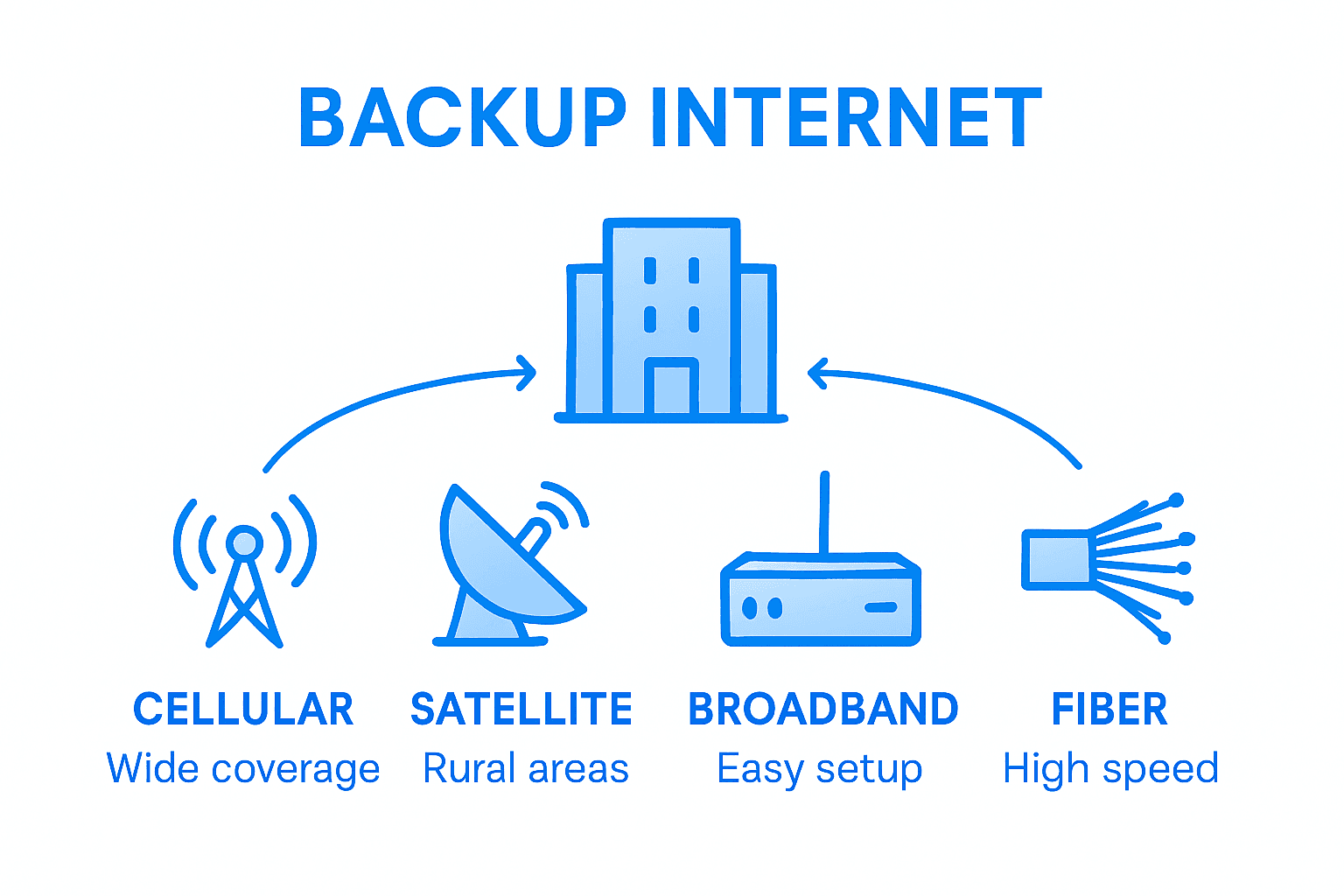
Selecting the appropriate backup internet solution depends on several critical factors, including business size, operational requirements, budget, and geographic location. Small businesses might prioritize cost-effective cellular solutions, while enterprises with mission-critical communications may invest in multiple redundant connections. Key considerations include switching speed, bandwidth capacity, reliability percentages, and compatibility with your existing network infrastructure. Businesses should also evaluate potential backup connections based on their primary internet technology – for instance, companies with fiber optic primary connections might select LTE or cable as backup alternatives.
Pro Tip: Conduct a comprehensive network risk assessment before implementing a backup internet solution, evaluating potential failure points and creating a detailed continuity plan that specifies exactly how and when backup connections will be activated.
Here’s a side-by-side comparison of common backup internet connection types and their key characteristics:
| Connection Type | Strengths | Limitations | Best Use Case |
|---|---|---|---|
| Cellular Wireless | Fast failover, flexible location | Coverage varies, data caps | Small to medium businesses |
| Satellite | Works in remote areas | Higher latency, weather impacts | Rural and isolated locations |
| Secondary Broadband | High reliability, strong speeds | May share infrastructure risks | Urban business redundancy |
| Dedicated Failover | Guaranteed uptime, instant switch | Higher cost, complex setup | Large enterprises, critical ops |
How Backup Internet Solutions Work
Backup internet solutions operate through sophisticated network redundancy mechanisms designed to provide seamless internet connectivity during primary connection failures. Business-grade backup systems automatically detect and respond to network interruptions, switching between different connection types with minimal disruption to critical business operations. The core principle involves maintaining a secondary internet connection that can instantly take over when the primary network experiences downtime.
Connection Pro demonstrates how advanced backup solutions function, utilizing intelligent switching technology that monitors network performance in real-time. These systems typically employ multiple detection mechanisms, including bandwidth monitoring, latency tracking, and packet loss analysis. When the primary internet connection shows signs of instability or complete failure, the backup system immediately activates, routing network traffic through an alternative connection pathway. This process happens so quickly that most users remain unaware of the technical handoff occurring behind the scenes.
The technical architecture of backup internet solutions involves several key components: network interface controllers, routing protocols, failover mechanisms, and monitoring software. Businesses can configure these systems with different priority levels, allowing them to specify which connections should activate first and under what specific conditions. Some advanced configurations even support simultaneous multi-path routing, distributing network traffic across multiple connections to optimize performance and reliability. This approach ensures that critical applications like cloud services, video conferencing, point-of-sale systems, and communication platforms remain operational regardless of primary network challenges.
Pro Tip: Configure regular automated testing of your backup internet solution to verify its effectiveness, simulating network outages to ensure your failover systems respond precisely as designed.
Key Costs, Risks, and Common Mistakes
Backup internet solutions represent a critical investment for businesses, but many organizations struggle with understanding their true financial implications. Businesses often hesitate to invest in backup internet due to perceived high costs, not realizing that the potential losses from network downtime far outweigh the initial implementation expenses. Small to medium-sized businesses can expect to spend between $50 to $300 monthly for comprehensive backup internet services, which is significantly less than the potential revenue lost during extended network interruptions.
Solutions like Comcast’s Connection Pro demonstrate how affordable continuity can be — often a fraction of what a single hour of downtime costs. The most common mistakes businesses make include selecting incompatible backup technologies, failing to regularly test failover systems, and underestimating bandwidth requirements. Risk factors range from complete operational shutdown to partial service degradation, with potential financial impacts including lost productivity, missed sales opportunities, damaged client relationships, and compromised communication channels.
The primary risks associated with inadequate backup internet solutions extend beyond immediate financial losses. Businesses may experience significant reputation damage, especially in industries requiring constant connectivity like healthcare, finance, and technology services. Cybersecurity vulnerabilities increase during network transitions, potentially exposing sensitive data during unstable connections. Advanced backup internet strategies involve comprehensive risk assessment, multiple redundancy layers, and proactive monitoring systems that can dynamically route network traffic and maintain consistent performance across different connection types.
Pro Tip: Conduct a thorough cost-benefit analysis of potential backup internet solutions, calculating potential hourly revenue loss during network downtime to justify the investment in robust backup infrastructure.
Selecting the Right Backup Internet Provider
Backup internet providers require careful evaluation to ensure business continuity and network resilience. Businesses must consider multiple critical factors when selecting a backup internet solution, including data transfer stability, network reliability, and the provider’s ability to meet specific organizational requirements. Key assessment criteria involve examining technical capabilities, geographic coverage, failover speed, and compatibility with existing network infrastructure.
The selection process involves comprehensive technical and strategic analysis. Internet service providers like Verizon, Frontier Business, and AT&T Business offer varied backup connectivity options that cater to different business needs. Critical evaluation metrics include network redundancy mechanisms, maximum uptime guarantees, scalability of services, pricing structures, and technical support responsiveness. Businesses should prioritize providers offering multiple connection types – such as cellular, satellite, and alternative broadband networks – to create robust failover strategies.
Technical considerations extend beyond basic connectivity. Advanced backup internet providers should demonstrate sophisticated routing capabilities, real-time network monitoring, automatic failover technologies, and seamless integration with existing network architectures. Organizations must assess potential providers based on their ability to maintain consistent bandwidth, minimize latency during network transitions, and provide comprehensive cybersecurity protections. Additional evaluation factors include contract flexibility, service level agreements, geographical coverage, and the provider’s track record of maintaining network stability during high-stress scenarios.
Pro Tip: Develop a comprehensive technical scorecard when evaluating backup internet providers, ranking potential vendors across multiple performance metrics including reliability, speed, support responsiveness, and cost-effectiveness.
The following table summarizes key considerations when selecting a backup internet provider:
| Evaluation Criterion | Why It Matters | What to Check |
|---|---|---|
| Failover Speed | Reduces business disruption | Automatic, near-instantaneous switch |
| Coverage & Scalability | Supports business growth and all sites | Geographic reach, scalable plans |
| Support Responsiveness | Ensures quick issue resolution | 24/7 support, SLA guarantees |
| Security Integration | Protects sensitive data during failover | Encrypted connections, monitoring |
Secure Your Business Continuity with Voipcom’s Backup Internet and Communications Solutions
Internet downtime can lead to lost revenue, damaged reputation, and disrupted operations. The article highlights how backup internet guarantees uninterrupted connectivity through automatic failover and diverse connection types. If your business needs to avoid costly interruptions and maintain seamless communications, integrating a robust backup internet solution with your cloud-based phone system is essential. Voipcom specializes in delivering fully managed, reliable backup internet alongside advanced business phone services designed to enhance productivity and protect your business from unexpected outages.
Voipcom offers:
- Managed backup internet services tailored for small to medium businesses
- Scalable Hosted PBX phone systems with automated failover
- Comprehensive support for Microsoft Teams integration and AI-powered calling
- Local, responsive support with no hidden fees ensuring predictable costs

Don’t let network disruptions halt your business. Discover how Voipcom’s combined backup internet and modern communication solutions can keep you connected anytime. Visit Voipcom’s Solutions to get started today. Protect your business now with reliable technology that adapts to your needs.
Frequently Asked Questions
What is backup internet?
Backup internet is an alternative network connection that provides reliable access when the primary internet service experiences disruptions or outages. It ensures uninterrupted connectivity for critical business operations.
Why do businesses need backup internet?
Businesses need backup internet to prevent downtime, which can lead to significant financial losses, damaged reputations, and disrupted operations. Having a secondary connection allows for seamless continuity in communication and transactions during outages.
What types of backup internet connections are available?
Common types of backup internet connections include cellular wireless (4G/5G), satellite, secondary broadband, and dedicated failover circuits. Each type has its strengths and suitability based on business needs and geographic location.
How do backup internet solutions work?
Backup internet solutions operate through automatic switching mechanisms that detect network interruptions and switch to a secondary connection with minimal disruption. These systems use monitoring technologies to ensure a seamless transition when the primary connection fails.