


Deciding how to scale communication across your Arizona or Colorado law firm often feels like a puzzle. Flexible phone systems are more than convenience—they are necessary for supporting growing caseloads and maintaining compliance with regulations like HIPAA. Understanding cloud phone system scalability helps IT managers find solutions that adjust instantly to team size, workload, and the unique demands of legal practice, providing a strong foundation for secure and efficient communication.
Key Takeaways
| Point | Details |
|---|---|
| Scalability Importance | Cloud phone systems provide the ability to grow and adapt based on organizational needs, essential for law firms navigating fluctuating communication demands. |
| Deployment Models | Law firms can choose from private, public, hybrid, and community clouds, each offering unique security and scalability benefits tailored to specific operational needs. |
| Cost Management | Transitioning to cloud-based solutions helps firms shift from capital expenditures to predictable operational expenses with consumption-based pricing models. |
| Security Compliance | Robust cybersecurity measures, including multi-factor authentication and end-to-end encryption, are crucial for protecting sensitive client communications in cloud environments. |
Defining Scalability in Cloud Phone Systems
Scalability represents the fundamental capability of cloud phone systems to grow and adapt dynamically to an organization’s changing communication needs. For law firms, this means having a telecommunications infrastructure that can seamlessly expand or contract without requiring significant hardware investments or complex reconfiguration.
Related: VoIP phone service in Scottsdale, VoIP phone service in Conifer, and business VoIP with local setup and support.
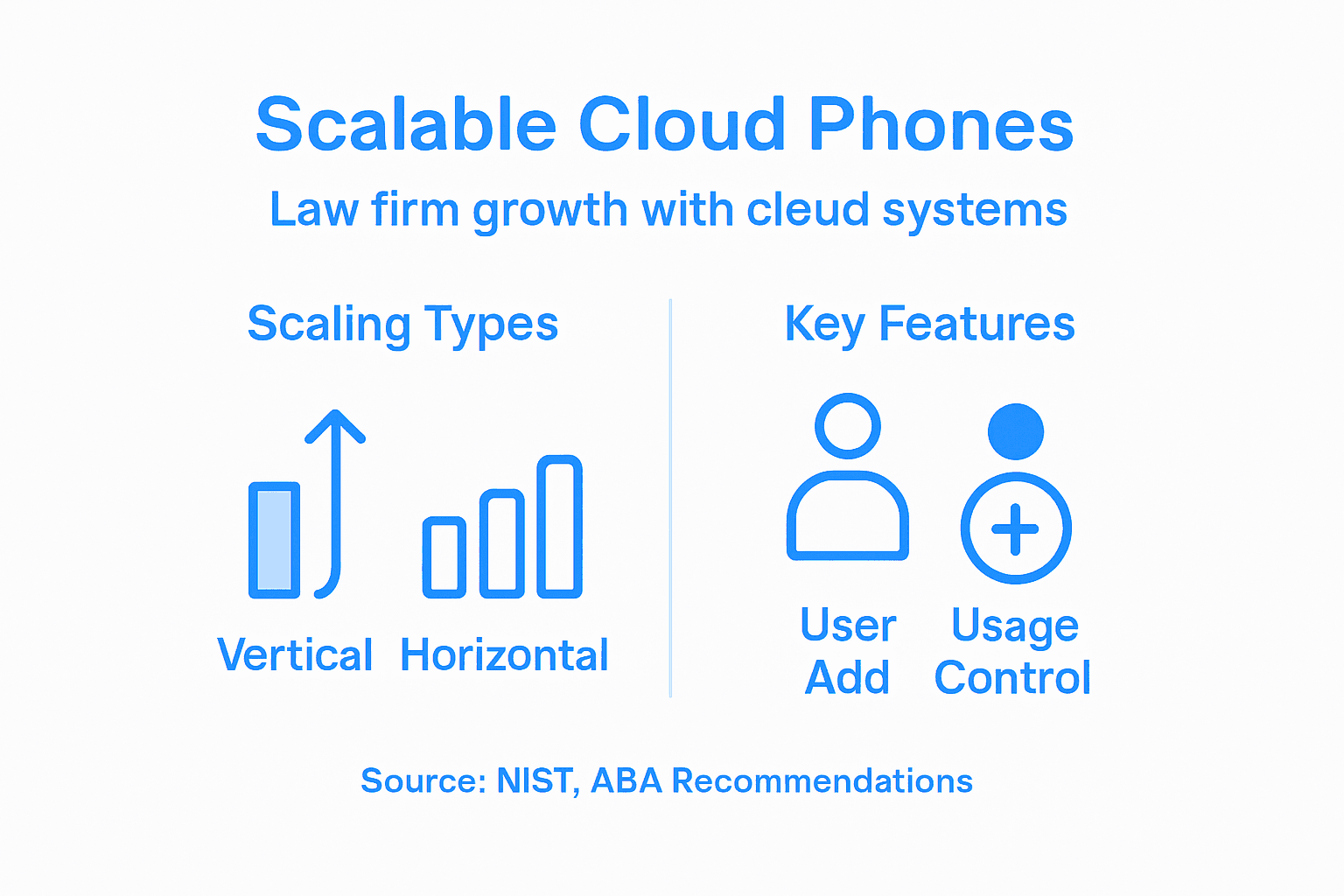
At its core, cloud phone system scalability involves two primary mechanisms: vertical and horizontal resource adjustment. Vertical scaling allows adding computational resources to existing network nodes, while horizontal scaling enables introducing additional nodes to distribute communication workloads.
Specifically for law firms, scalable cloud phone systems offer critical advantages:
- Instant user addition without physical infrastructure changes
- Flexible capacity to handle seasonal case volume fluctuations
- Cost-effective resource management
- Seamless integration with remote and hybrid work environments
- Enterprise-grade reliability without massive upfront investments
Cloud phone system scalability fundamentally transforms how legal practices manage telecommunications. Dynamic resource allocation ensures that communication systems can support increasing user counts, concurrent sessions, and throughput without performance degradation.
Pro tip: When evaluating cloud phone systems, request detailed scalability performance metrics and understand the precise mechanisms for adding or removing user licenses.
Types of Scalability and Deployment Options
Cloud phone systems offer law firms multiple strategies for scaling their communication infrastructure, with each approach designed to address unique organizational requirements. Scalability in cloud computing encompasses three primary models: vertical scaling, horizontal scaling, and diagonal scaling, each providing distinctive advantages for legal communication networks.
Vertical Scaling (Scale Up) involves increasing computational power within existing infrastructure. For law firms, this means enhancing a single server’s capabilities by adding more processing capacity, memory, or storage to support growing communication demands without introducing additional hardware complexity.
Deployment Models for Law Firms:
- Private Cloud: Maximum security and control
- Public Cloud: Cost-effective and highly scalable
- Hybrid Cloud: Balanced approach with flexible resource allocation
- Community Cloud: Shared infrastructure for similar organizational needs
Horizontal Scaling (Scale Out) represents a more distributed approach, enabling law firms to add multiple servers or nodes to spread communication workloads. This method provides superior redundancy and allows seamless expansion of user capacity without significant infrastructure redesign.
Cloud deployment strategies enable legal practices to select models that align precisely with their operational security, budget, and technological requirements. Diagonal Scaling, a hybrid approach, combines vertical and horizontal scaling techniques to offer unprecedented flexibility in resource management.
Pro tip: Consult with cloud communication specialists to design a scalability strategy that matches your law firm’s specific growth trajectory and communication complexity.
Review these core deployment options for law firms:
| Deployment Model | Security Level | Scalability | Typical Use |
|---|---|---|---|
| Private Cloud | Highest | Moderate | Sensitive data, strict compliance |
| Public Cloud | Standard | High | Cost-driven firms, rapid scaling |
| Hybrid Cloud | High | Customizable | Firms with varied workload needs |
| Community Cloud | Moderate | Shared | Organizations with common standards |
Here’s a comparison of cloud phone system scalability models for law firms:
| Scaling Model | How It Works | Ideal Use Case | Key Benefit |
|---|---|---|---|
| Vertical Scaling | Add resources to existing servers | Small firms with predictable growth | Simplifies hardware management |
| Horizontal Scaling | Add new servers or nodes | Large firms with fluctuating workloads | Enhances redundancy and user capacity |
| Diagonal Scaling | Combine vertical and horizontal methods | Firms with mixed growth patterns | Maximum flexibility in scaling |
Key Features Supporting Rapid Growth
Cloud phone systems for law firms are evolving beyond traditional communication tools, integrating advanced features that directly support organizational scalability and efficiency. Emerging technologies enable automated workflows that transform how legal practices manage client interactions, case volumes, and operational complexity.

Automated Scaling Features provide law firms with unprecedented flexibility in managing communication infrastructure. These intelligent systems dynamically adjust resources based on real-time demand, ensuring optimal performance during peak periods without requiring manual intervention or significant capital investments.
Key technological capabilities supporting rapid growth include:
- Automatic user provisioning
- Intelligent call routing
- AI-powered consultation scheduling
- Seamless mobile and desktop integration
- Scalable bandwidth allocation
- Compliance monitoring tools
Cloud security mechanisms play a critical role in supporting growth by ensuring that expanded communication networks maintain robust protection. Advanced features like multi-factor authentication, end-to-end encryption, and granular access controls enable law firms to scale securely without compromising sensitive client data.
The most sophisticated cloud phone systems incorporate adaptive intelligence that learns from communication patterns, suggesting optimization strategies and predicting future infrastructure requirements. This predictive capability allows law firms to stay ahead of technological demands and maintain competitive communication infrastructure.
Pro tip: Conduct quarterly reviews of your cloud phone system’s performance metrics to proactively identify scalability opportunities and potential optimization strategies.
Cost Implications and Predictable Pricing
Cloud phone systems transform financial models for law firms, shifting from unpredictable capital expenditures to manageable operational expenses. Cloud cost optimization strategies enable legal practices to precisely control telecommunications spending while maintaining flexible infrastructure.
Traditional phone systems required substantial upfront investments in hardware, maintenance contracts, and dedicated infrastructure. Modern cloud-based solutions eliminate these barriers by offering consumption-based pricing models that allow law firms to pay exclusively for the communication resources they actually utilize.
Pricing strategies for scalable cloud phone systems typically include:
- Per-user monthly subscriptions
- Tiered feature packages
- Pay-as-you-go bandwidth allocation
- Flexible user license management
- No long-term hardware commitment
- Predictable monthly budgeting
NIST cloud computing research highlights the transformative potential of usage-based pricing, which allows law firms to dynamically adjust communication resources. This approach converts substantial capital expenses into predictable operational costs, providing financial flexibility and eliminating overprovisioning risks.
Advanced cloud phone systems offer granular cost controls, enabling legal practices to optimize spending through real-time usage analytics and intelligent resource allocation. By tracking communication patterns, firms can make data-driven decisions about their telecommunications infrastructure.
Pro tip: Request detailed usage reports from your cloud phone system provider to identify potential cost optimization opportunities and track communication resource efficiency.
Compliance, Security, and Legal Considerations
Cloud phone systems introduce complex compliance challenges for law firms, requiring robust security frameworks that protect sensitive client communications and meet stringent regulatory standards. CISA and NSA security guidelines emphasize critical protection mechanisms essential for maintaining legal industry confidentiality.
Legal practices must implement comprehensive security strategies that address multiple layers of potential vulnerability. Cybersecurity protocols must encompass network architecture, data transmission, user authentication, and continuous risk monitoring to ensure complete protection of confidential information.
Key compliance and security considerations include:
- Multi-factor authentication
- End-to-end encryption
- Regular security audits
- Granular access controls
- Comprehensive user activity logging
- Automated threat detection systems
- HIPAA and attorney-client privilege compliance mechanisms
The American Bar Association’s cybersecurity recommendations underscore the importance of developing risk-based information security programs specifically tailored to legal industry requirements. These frameworks must address unique challenges such as protecting privileged communications, maintaining client confidentiality, and preventing unauthorized data access.
Modern cloud phone systems integrate advanced security features that go beyond traditional telecommunications infrastructure, providing law firms with intelligent, adaptive protection mechanisms that evolve alongside emerging technological threats.
Pro tip: Conduct annual comprehensive security assessments and maintain detailed documentation of your cloud communication system’s compliance measures to demonstrate proactive risk management.
Unlock Seamless Scalability for Your Law Firm with Voipcom
Managing your law firm’s communication growth should never be a struggle. As highlighted in the article, scalability in cloud phone systems is crucial to handle fluctuating workloads, add users instantly, and maintain security without costly infrastructure changes. If you are seeking flexible, cost-effective solutions that adapt dynamically to your firm’s evolving needs, Voipcom offers exactly that with our fully managed cloud phone systems designed for modern legal practices.
With features like AI-powered calling, Microsoft Teams integration, and robust security protocols tailored for compliance, Voipcom ensures your communication infrastructure grows with you—whether you scale vertically, horizontally, or diagonally. Our transparent, all-inclusive pricing means no hidden fees and straightforward budgeting that matches your growth. Experience local, live support ready to handle setup, support, and maintenance so your focus remains on clients.

Ready to transform your law firm’s communication with scalable, secure, and modern cloud phone solutions? Visit Voipcom today to explore our Hosted PBX business phone systems and discover how we simplify your transition from legacy systems. Don’t wait for complexity or costs to hold back your growth. Connect with us now for a custom scalable solution tailored to your needs.
Frequently Asked Questions
What is scalability in cloud phone systems for law firms?
Scalability in cloud phone systems refers to the ability to dynamically adjust the telecommunications infrastructure to meet an organization’s changing communication needs, allowing law firms to add or remove users and resources without significant hardware investments.
What are the types of scalability available for cloud phone systems?
The main types of scalability for cloud phone systems are vertical scaling (adding resources to existing infrastructure), horizontal scaling (adding more servers or nodes), and diagonal scaling (combining both methods) to support diverse growth patterns.
How can law firms benefit from using a scalable cloud phone system?
Law firms can benefit from scalable cloud phone systems through instant user addition, flexible capacity for seasonal workloads, cost-effective resource management, and seamless integration with remote work environments, all without substantial upfront costs.
What key features support scalability in cloud phone systems?
Key features that support scalability include automatic user provisioning, intelligent call routing, AI-powered scheduling, scalable bandwidth allocation, and advanced security measures like multi-factor authentication and encryption.
Recommended
- Why Switch to Cloud Phone for Law Firms – Voipcom
- Business Telephony Upgrade Workflow for Law Firms – Voipcom
- 7 Top Features of Modern Phone Systems for Law Firms – Voipcom
- 7 Top Telephony Features for Law Firms in 2025 – Voipcom
- Pete Ketchum | Business Scaling Coach & Organizational Psychologist
- Pete Ketchum | Organizational Psychologist & Author
Ready for the cloud? Explore the Voipcom hosted PBX — a full PBX in the cloud, fully managed, with no hardware.